Tag Archives: UNFCCC

The Real Cost of Energy: Why Renewables Make More Sense

Op Ed by IRENA Director-General Adnan Z. Amin (originally published in the Huffington Post)

Energy-related greenhouse gas emissions have plateaued for the second year running – an extraordinary fact considering the global economy grew by more than 3% in the same period. This news, coming just before leaders from 175 countries gathered in New York to sign the Paris Agreement, provides a welcome sign of real progress in the fight against climate change.

But stabilizing energy-related emissions is not enough to fulfil the ambition of the Paris Agreement – the kind of ambition needed to avoid the worst impacts of climate change. This will require using energy more efficiently, and transitioning rapidly (roughly six times faster than today’s pace) to an energy system powered by renewables. IRENA recently released the second edition of its Roadmap for a Renewable Energy Future (REmap) which provides recommendations on how to do just that.

The research shows that accelerating the deployment of renewables on a scale needed to keep global temperature rise at or below 2°C is both technically feasible and economically affordable, with many additional benefits for health, economic growth and employment. In fact, doubling the share of renewable energy globally would save between $1.2 and $4.2 trillion per year thanks to avoided expenditures on climate change and air pollution. These savings are 4 to 15 times larger than the cost of deployment. In economic terms these savings would amount to between 0.9% – 3.3% of global GDP in 2030.

But governments must do two key things to achieve this doubling:

1. Ensure energy prices reflect real costs

There is a persistent misperception that renewable energy is costly. Quite apart from the fact that renewable energy costs are coming down rapidly, energy prices do not actually reflect its real costs to society.

Indoor and outdoor air pollution caused by the burning of fossil fuels is killing millions of people worldwide. In Europe, where 600,000 people suffered from air pollution-related disease or premature death in 2010, societal costs were estimated at $1.6 trillion.

There are also other heavy costs associated with fossil fuels and nuclear power that do not apply to renewable energy: oil spills; climate change impacts; radioactive waste storage and disposal; and ocean acidification for example.

Yet none of these costs are factored into the price we pay for energy – instead, we pay for them with our tax dollars, through our health insurance premiums, and with the degradation of our public lands and seas.

If energy prices were to reflect its true costs, there is no question that renewables would consistently be the least expensive option. And this is even before factoring in the positive macroeconomic benefits of renewables, such as higher economic growth, new job creation and trade advantages.

2. Let the private sector do its job

There is another persistent perception that renewable energy investments are risky.

Governments can reduce the risk by letting the private sector do its job: by passing laws, policies and regulations which provide a fair, stable and predictable investment environment.

For example, they could level the playing field between subsidies for renewables on the one hand, and fossil fuels and nuclear power on the other. Since 2009, governments have been working to phase out fossil fuel subsidies, with some success. But even today, four dollars are spent to subsidize the consumption of fossil fuels for every one dollar spent to subsidize renewable energy. With oil, gas and coal prices currently at historic lows, it is now easier than ever for governments to correct this problem.

There are many other policies which would spur the accelerated deployment of renewable energy. Enshrining renewable energy targets in law, streamlining planning procedures, and/or introducing carbon pricing or taxation at a level which reflects true costs are options that would send a powerful market signal to investors.

The fact remains that stabilizing emissions alone is not enough. If we are to meet our social, economic, environmental and development goals, we must remove the remaining barriers to renewable energy deployment and quickly accelerate the energy transition already underway.

Thought Leaders Talk Renewable Energy Solutions, Innovation and Action at Fourth Annual IRENA Financial Times Event

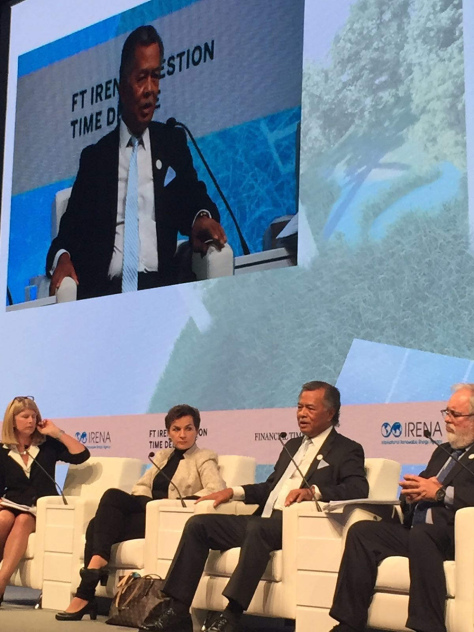
Over 500 leaders from government, business and civil society gathered yesterday at the headquarters of IRENA to discuss scaling up renewable energy as the cornerstone of global climate change mitigation. For the fourth consecutive year, the Financial Times-IRENA Question Time Debate provided a unique opportunity to discuss the international renewable energy agenda following the conclusion of IRENA’s annual Assembly.

Some notable quotes from the event:

“If we are going to decarbonise to remain below 2 centigrade, it requires the transformation of economies, energy systems, the way we do business and even our lifestyles.”Adnan Z. Amin, IRENA Director-General

Newsroom_FT2From left to right: Pilita Clark, Environmental Correspondent, Financial Times; Christiana Figueres, Executive Secretary, UNFCCC; Henry Puna, Prime Minister, Cook Islands; Miguel Arias Cañete, European Union Commissioner for Climate Action & Energy
“Policy makers must develop stable, practical regulations. If the framework is not there, investment will not follow.” – Miguel Arias Cañete, European Union Commissioner for Climate Action & Energy

“We have a goal of 100% renewables by 2020 and we’re on course to achieve that. We will be at 80% by next year.” – Henry Puna, Prime Minister, Cook Islands

“One of the obstacles is market distortion – there are certain oil subsidies and other regulatory policies from legacies that incentivise generation models.”- Kyung-Ah Park, Head of Environmental Markets Group, Goldman Sachs, on obstacles to renewable energy deployment

“This is not for the light of heart, it’s a battle, but we are going to win. We have drawn the boundary around what we are going to emit. By the year 2050, we will have a global economy that is down to net zero.” Christiana Figueres, Executive Secretary, UNFCCC

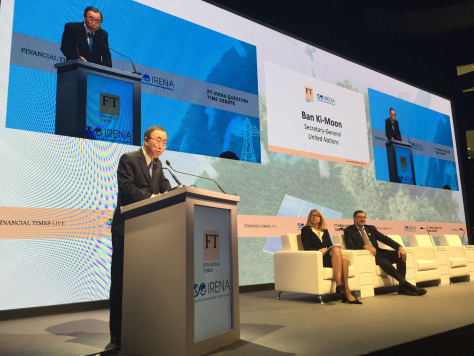
“We can no longer burn our way into global prosperity. We all know that renewable energy is limitless and will last forever, offers us security and peace of mind. We should have everyone on board for shared prosperity. Events like this are vital to spread the word.” – Ban Ki-moon, United Nations Secretary-General

Newsroom_FT3Ban Ki-moon, United Nations Secretary-General

The event took place immediately following the conclusion of the sixth IRENA Assembly, which brought together more than 1,000 energy leaders from 150 countries to set the global renewable energy agenda and make concrete steps to accelerate the ongoing global energy transition.

Newsroom_FT6Panellist Kyung-Ah Park, Head of Environmental Markets Group, Goldman Sachs
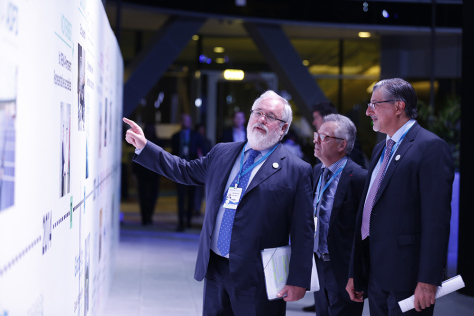
Newsroom_FT5Panellist Miguel Arias Cañete, European Union Commissioner for Climate Action & Energy, looking at the IRENA history timeline at IRENA headquarters

More on the event: https://live.ft.com/Events/2016/FT-IRENA-Question-Time-Debate-2016

Event photos: https://www.flickr.com/photos/irenaimages/albums/72157661038902124

Energy Day at COP21: Unlocking Climate Solutions

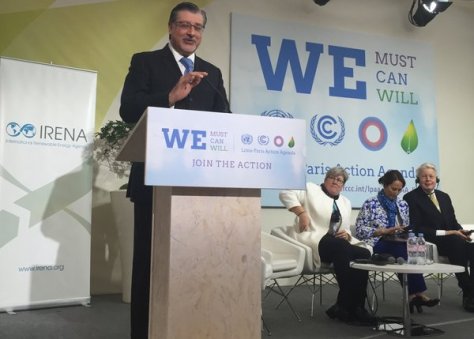
An increasing number of governments, businesses and cities are taking action to accelerate the ongoing renewable energy transition. To spur momentum at COP21, yesterday was designated Energy Day in the context of the Lima-Paris Action Agenda (LPAA).

As described on the LPAA website, “The Lima-Paris Action Agenda brings both state and non-state actors together on the global stage to accelerate cooperative climate action now and into the future in support of the new, universal climate change agreement which governments will reach in Paris.”

Given the massive global focus on the Paris negotiations, it was no surprise that a slew of exciting new commitments were announced. The program for the day was literally packed with speakers and discussion panels.

The morning session focused on renewable energy and was organized by IRENA, while the spotlight moved to energy efficiency and access in the afternoon, and was organized by SE4All.

CVnVjj0WwAAIYe3

These were some of yesterday’s most important announcements:

  • The official launch of the Global Geothermal Alliance, which is set to achieve a 500% increase in global installed capacity for geothermal power generation and a 200% increase for geothermal heating by 2030.
  • The expansion of the Africa Clean Energy Corridor to Western Africa. The ACEC, currently operating in East and South Africa, is boosting renewable power deployment, reducing carbon emissions and supporting sustainable, climate-friendly economic growth. By facilitating a larger electricity market, the initiative could attract sufficient investments to meet half of all power needs in eastern and southern Africa by 2030.
  • The SIDS Lighthouses Initiative announced that Saint Lucia is the 29th island to join the initiative. Since its launch in September 2014, 18 SIDS have developed roadmaps for deployment of renewable energy, $150 million has been mobilised for renewable energy projects on SIDS, and 18 MW of renewable energy has been deployed. The initiative will also announce a new pilot project development facility to help develop more bankable projects.
  • The Sustainable Energy Marketplace, a matchmaking platform connecting renewable energy projects and investors, was presented. The Marketplace expects to house 100 projects by the beginning of 2016, and to mobilize USD 10 billion in project financing over the next 3 years.
  • The launch of the Clean Water Desalination Alliance, which will gather commitments and actions to decrease emissions in desalinization plants. This initiative could save up to 80 Mln tCO2 in 2040 if globally implemented.
  • RE100, the global collaborative business initiative whose members commit to sourcing 100% of their electricity from renewables, announced that six new members had just joined. This brings the total to 53 companies in all.

“The energy transition is underway worldwide. But to make the next step-change, the world must utilise all useful technologies, increase ambition among all actors in all regions of the world, and mobilise the funds needed to enable the transition.” – Adnan Z. Amin, IRENA Director-General

Full list of announcements.


7 Things You Need to Know about Renewable Energy at COP21

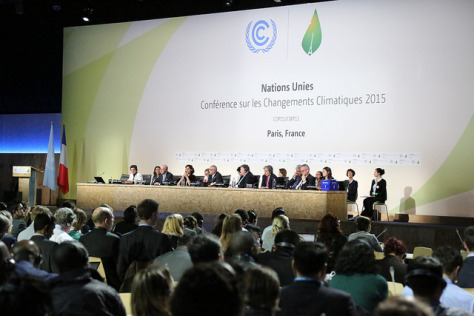
As world leaders take the stage today at the opening of COP21, transitioning to a world powered by renewable energy will be at the core of their messages, whether they explicitly say so or not. Here are seven things you need to know about renewable energy as it relates to COP21:

ONE: Renewable energy is key to decarbonisation: A crucial issue on the table at COP21 is whether to adopt a long-term decarbonisation goal. To date, more than 120 countries have expressed support for such an approach. Given that the energy sector accounts for two-thirds of global emissions, renewable energy will be central to achieving whatever goal is ultimately adopted.

TWO: Energy Day is part of the Renewable Energy Track at the COP: The RE track will kick-off with a series of workshops on December 4 aimed at identifying and demonstrating important opportunities and benefits offered by renewables in a range of sectors including agriculture, industry, cities and transport.
22773847963_458502ec09_z

THREE: Exciting developments and innovations will be live streamed: On Sunday, December 6, a high level conference will be held in the heart of Paris looking at exciting developments and innovations in relation to renewable energy. The program and speaker line-up is available here, and while attendance is by invitation-only the conference will be live-streamed (URL to be announced at http://re-energising.org/)

FOUR: Paris isn’t Copenhagen: The renewable energy landscape has changed dramatically in the six years since the last major UN climate conference in Copenhagen, 2009. Solar PV module costs have fallen as much as 80% since then, and wind turbine prices have fallen by almost a third. In just the last three years, the world added more than 100 gigawatts of new renewable energy capacity every year – a number equivalent to the total installed generation capacity of Brazil. Renewable energy technologies are creating more jobs on average than fossil fuel technologies.

FIVE: It’s all about momentum: Renewable energy is a good news story, changing the climate narrative from one of sacrifice to one of opportunity. This allows governments to commit to going farther and faster, and thus creates momentum for the COP. The reverse is also true: it is the countries with strong renewable targets and enabling policies in place where deployment is increasing the fastest. COP21 has the power to speed up the renewable energy transition by taking decisions which put the world on a pathway to keeping global temperature rise as far below 2°C is possible.

SIX: Countries are making bold commitments: Countries representing more than 90% of the global economy have submitted pledges (INDCs in COP terminology) to reduce their emissions. Nearly all of them address energy consumption or production. In addition, 164 countries have adopted renewable energy targets aimed at speeding up the transition.

SEVEN: Monday December 7 is Energy Action Day at COP21: The morning will focus on renewable energy, while energy access will be addressed in the afternoon. A wide range of new initiatives will be announced by governments and business. More information here.

To join the conversation about renewable energy during COP21, follow #REenergise on Twitter.


Countries Say Out with Fossil Fuels, in With Renewable Energy As Climate Negotiations Resume

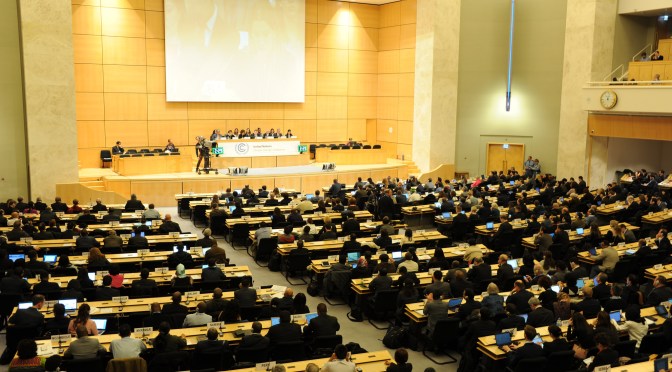
From 8-13 February, government leaders from around the globe gathered in Geneva, Switzerland to kick off a busy year of climate change negotiations. The UN climate change conference is just 10 months away and these sessions aim to smooth the way to a successful climate agreement come December.

The Ad Hoc Working Group on the Durban Platform for Enhanced Action (ADP), formed under the United Nations Framework Convention on Climate Change (UNFCCC), succeeded in further expanding a draft negotiation text which will be used as a baseline for the remaining negotiations this year.

The full text is here, and a session brief is here, but one key takeaway was the broad acknowledgement that fossil fuel subsidies must be phased out while actions on renewable energy and energy efficiency must be scaled up.

The next step for governments is to present their national action plans (referred to as intended nationally ‎determined contributions – INDCs) in support of the new climate agreement. The national action plans will detail how countries plan to step away from fossil fuels, step towards renewable energy and increase their resilience to climate change.

IRENA participated in the session to share resources with delegates that can aid in the elaboration of their national action plans. For example, IRENAs renewable readiness assessments (already completed with 22 individual countries), island roadmaps, and the Remap 2030 reports all contain valuable information on the global potential and opportunities for renewable energy. Resource, the newly launched online search platform, also contains data and information countries can use as they consider their contributions.

The IRENA team gave a presentation focused on the REmap 2030 work programme, reviewing the global status of renewable energy deployment and the potential, cost, and benefits of doubling the global share of renewables by 2030.

As the road to Paris continues, IRENA will continue working with countries to aid where possible in the development of their INDCs.

For more information, email [email protected]

Climate Change and Renewable Energy: The Good, The Bad, and The Necessary

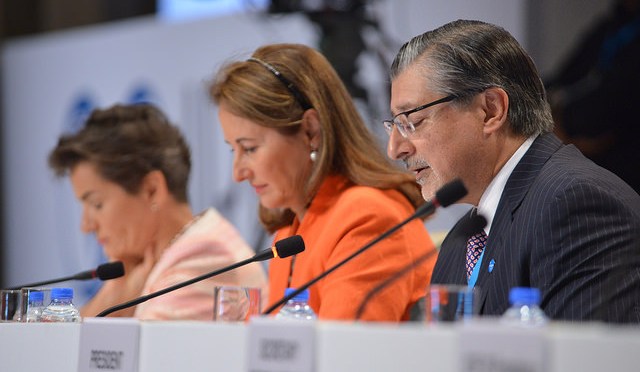
During the last day of IRENA’s fifth Assembly today, experts from across the climate change sphere kicked off discussions on the role of renewable energy in climate change. IRENA Director-General Adnan Amin, Executive Director of the UN Climate Change Secretariat Christiana Figueres, French Minister for Ecology, Sustainable Development and Energy Ségolène Royal and Peru Climate Change Representative Rómulo Acurio, led discussions from the panel.

It was clear from the session that (1) there is no solution to climate change without enabling policies for renewable energy and (2) there is no global renewable energy uptake without a strong climate agreement.

Here is an overview of the bad, the good and the just plain necessary when it comes to climate change and renewable energy:

THE BAD:

  • 2014 was the hottest year on record.
  • The release of the IPCC fifth assessment report confirmed that emissions are at their highest level in over 800 years and must fall by 40 – 70 percent by 2030 if we are to stay at or below the 2 degree greenhouse gas level.
  • Policies currently in place will not decrease emission levels enough to avoid catastrophic climate change.
  • Global emissions continue to grow and vested interests pose a serious threat to changing the status quo.

THE GOOD:

  • Growing urgency has led to growing engagement of stakeholders at local, national and regional levels.
  • Many countries are moving on commitments:
    • the EU aims to cut emissions by at least 40 percent of 1990 levels by 2030
    • China and the US have agreed to limit their combined emissions
    • India announced its plans to increase its solar power capacity by 100 megawatts by 2022
    • France announced it would no longer provide development finance for the building of coal-fired power stations
    • Countries have pledged resources amounting to over 10 billion US dollars to the Green Climate Fund.
  • REmap2030 shows that doubling the global share of renewable energy would mitigate climate change, and actually save money in the long run while creating millions of jobs worldwide.
  • Renewable energy technologies are now readily available – they are robust and efficient, increasingly able to generate power even in sub-optimal conditions. Prices continue to decline, making them cost-competitive
  • Investment in renewables has risen from 55 billion dollars in 2004 to 310 billion dollars in 2014
  • Renewables are ready to take centre stage as viable, affordable and available solutions to climate change

THE NECESSARY:

  • REmap 2030, shows that doubling the share of renewables could help mitigate climate change, but this would require investments in clean energy in the order of 44 trillion US dollars until 2050, compared to a business as usual scenario.
  • USD 90 trillion will be invested in infrastructure in the next 15 years. This development must be done using technologies that ensure a low carbon future.
  • Leaders must agree a new climate deal in the next 10 months. We know it is possible to achieve the 2 degree objective and avoid the catastrophic impacts of climate change, if we continue and accelerate action on climate change right now.