Category Archives: COP21

7 Things You Need to Know about Renewable Energy at COP21

As world leaders take the stage today at the opening of COP21, transitioning to a world powered by renewable energy will be at the core of their messages, whether they explicitly say so or not. Here are seven things you need to know about renewable energy as it relates to COP21:

ONE: Renewable energy is key to decarbonisation: A crucial issue on the table at COP21 is whether to adopt a long-term decarbonisation goal. To date, more than 120 countries have expressed support for such an approach. Given that the energy sector accounts for two-thirds of global emissions, renewable energy will be central to achieving whatever goal is ultimately adopted.

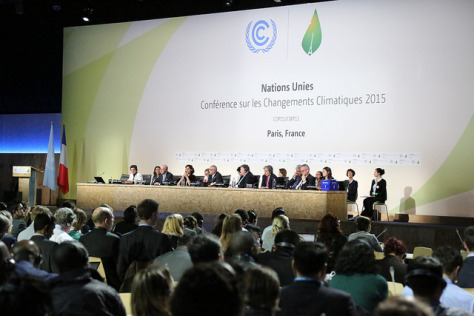
TWO: Energy Day is part of the Renewable Energy Track at the COP: The RE track will kick-off with a series of workshops on December 4 aimed at identifying and demonstrating important opportunities and benefits offered by renewables in a range of sectors including agriculture, industry, cities and transport.
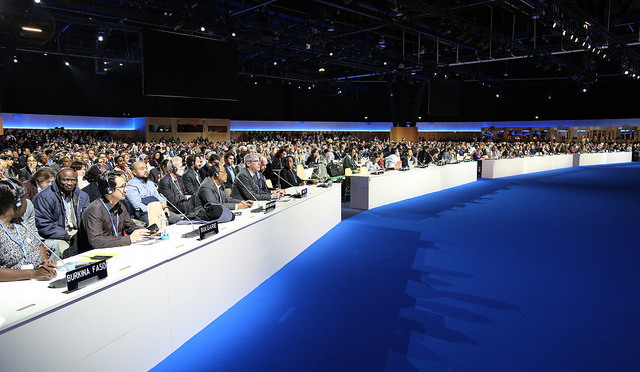
22773847963_458502ec09_z

THREE: Exciting developments and innovations will be live streamed: On Sunday, December 6, a high level conference will be held in the heart of Paris looking at exciting developments and innovations in relation to renewable energy. The program and speaker line-up is available here, and while attendance is by invitation-only the conference will be live-streamed (URL to be announced at http://re-energising.org/)

FOUR: Paris isn’t Copenhagen: The renewable energy landscape has changed dramatically in the six years since the last major UN climate conference in Copenhagen, 2009. Solar PV module costs have fallen as much as 80% since then, and wind turbine prices have fallen by almost a third. In just the last three years, the world added more than 100 gigawatts of new renewable energy capacity every year – a number equivalent to the total installed generation capacity of Brazil. Renewable energy technologies are creating more jobs on average than fossil fuel technologies.

FIVE: It’s all about momentum: Renewable energy is a good news story, changing the climate narrative from one of sacrifice to one of opportunity. This allows governments to commit to going farther and faster, and thus creates momentum for the COP. The reverse is also true: it is the countries with strong renewable targets and enabling policies in place where deployment is increasing the fastest. COP21 has the power to speed up the renewable energy transition by taking decisions which put the world on a pathway to keeping global temperature rise as far below 2°C is possible.

SIX: Countries are making bold commitments: Countries representing more than 90% of the global economy have submitted pledges (INDCs in COP terminology) to reduce their emissions. Nearly all of them address energy consumption or production. In addition, 164 countries have adopted renewable energy targets aimed at speeding up the transition.

SEVEN: Monday December 7 is Energy Action Day at COP21: The morning will focus on renewable energy, while energy access will be addressed in the afternoon. A wide range of new initiatives will be announced by governments and business. More information here.

To join the conversation about renewable energy during COP21, follow #REenergise on Twitter.
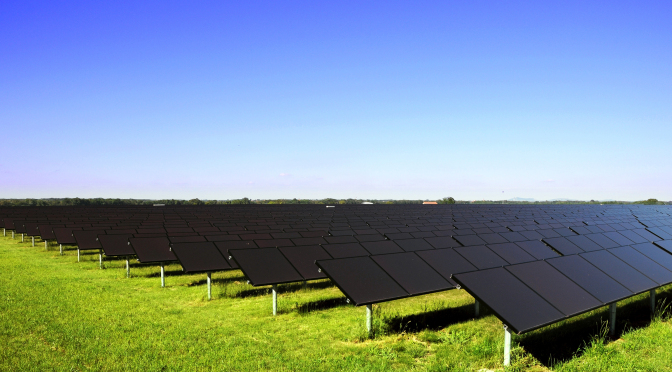
 

Renewables Are Changing the Climate Narrative from Sacrifice to Opportunity

Originally published in The Guardian

Oil-rich countries are choosing renewables as a means to create jobs, boost GDP and improve livelihoods – as well as reduce emissions

Accelerating signs of climate change and rising global temperatures are perhaps more pressing here in the Middle East, where IRENA is headquartered, than anywhere else on the planet.

Record-breaking temperatures made global headlines this year and a recent scientific study predicts the region will face heatwaves “beyond the limit of human survival” if climate change remains unchecked.

Indications are clear that after more than 20 years of negotiations among more than 190 countries, the UN climate conference in Paris in December – COP21 – will be a turning point in the fight against climate change. For the first time at any climate conference, renewable energy solutions will take centre stage in a series of high-profile events coupled with new commitments and announcements.

In doing so, it will also transform the climate change narrative from one of managing constraints to one of opportunity…

Read more at The Guardian.

IRENA’s Five Actions for a Sustainable Energy Future

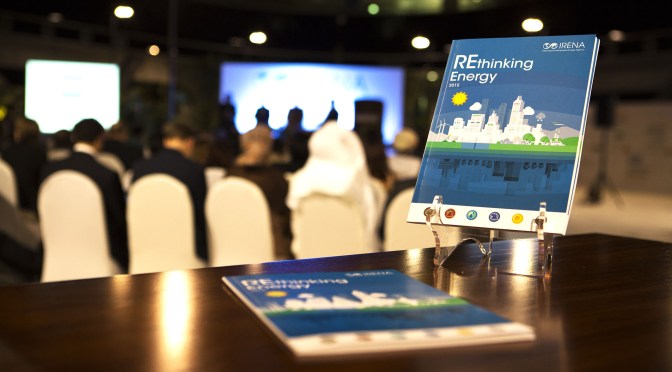
IRENA released a report this week that lays out a plan to limit global temperature rise. Rethinking Energy 2015 –Renewable Energy and Climate finds that reducing carbon emissions through the use of renewables and improving energy efficiency could mitigate the effects of climate change. Specifically, achieving a 36 per cent share of renewable energy, combined with implementing energy efficiency measures, would maintain global temperature rise to below 2oC.

“The energy sector accounts for more than two-thirds of global greenhouse gas emissions, and therefore must be the focus of climate action. Transitioning rapidly to a future fueled by renewable energy, accompanied by increasing energy efficiency, is the most effective way to limit global temperature rise. This transition is underway but it must be accelerated if we are to limit global temperature rise to two degrees Celsius.” – Adnan Z. Amin, IRENA Director-General

The report presents the following five actions that would further accelerate the deployment of renewable energy and secure a sustainable energy future:

  1. Strengthen the policy commitment to renewable energy. Enabling policies and regulatory frameworks create stable and predictable investment environments, help to overcome barriers, and ensure predictable revenue streams for projects. Setting renewable energy targets and formulating dedicated policies to implement them provides strong market signals, reflecting government commitment to the sector’s development.
  1. Mobilise investments in renewable energy. Public funding will remain an important catalyst and will need to increase, but the lion’s share of new investment in renewables will have to come from the private sector. To mobilise private investment, the strategy pursued must focus on risk mitigation instruments and structured finance tools to develop a strong pipeline of projects, and to unlock project financing and refinancing opportunities.
  1. Build institutional, technical and human capacity to support renewable energy deployment. From policy and regulatory design to project preparation, evaluation, development and financing, a wide array of skills needs to be built up in government ministries, financing institutions and regulatory agencies. And coordination between them is vital, in order to ensure, for instance, that physical infrastructure and complementary regulations, such as grid codes, keep pace with accelerating renewable energy development..
  1. Harness the cross-cutting impact of renewable energy on sustainable development. Achieving the Sustainable Development Goal (SDG) on energy will transform the energy system while helping meet other SDGs such as those on health, poverty alleviation, water and cities. Access to reliable, cost-effective and environmentally sustainable modern energy services can have a multiplier development impact. In particular, renewable energy solutions can expand electricity access, increase productivity, create jobs, improve water security and bolster poverty alleviation efforts. The wider sustainable development impact of renewable energy must be taken into account when strategies for the implementation of SDGs are developed.
  1. Enhance regional engagement and international cooperation on renewable energy development. Regional approaches and common initiatives can reduce costs, generate economies of scale, attract investments, boost financial capacity, stimulate cross-border trade and enable common progress in accelerating the deployment of renewable energy worldwide. To meet national goals and ambitions, countries would benefit from concerted action on renewables and climate mitigation that regional and international cooperation offers.

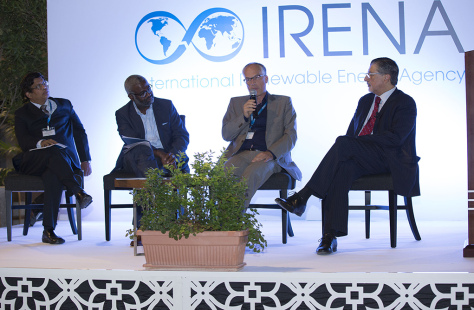
2015-11-25 01.13.17_newsroomRethinking Energy launch event on 22 November 2015 at IRENA Headquarters, Abu Dhabi, UAE. From left to right: Upendra Tripathy, Secretary, Minister of New and Renewable Energy, India; Conrod Hunte, Ambassador, Antigua and Barbuda; Martin Schoepe, Federal Ministry for Economic Affairs and Energy, Germany and IRENA Director-General Adnan Z. Amin.
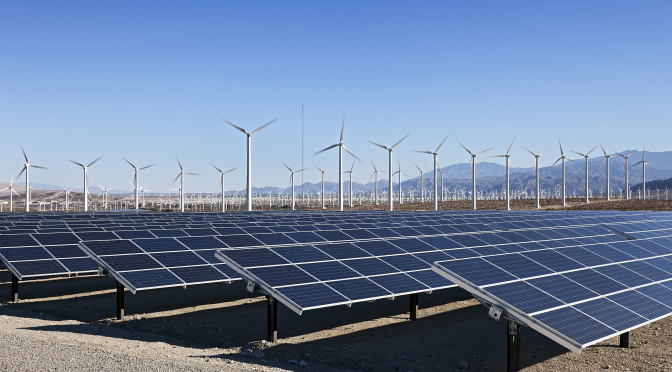
“It is now not a question of if the world ultimately transitions to a renewable energy future, but rather whether it will do so quickly enough. At the upcoming climate talks in Paris, it will be up to countries to commit to strong targets, and in turn, give a strong political signal to catalyse further investments in renewable energy.” – Adnan Z. Amin, IRENA Director-General

REthinking Energy – Renewable Energy and Climate is the second edition of the series outlining progress in the transition to a sustainable energy future.

Download the full report.

More photos from the launch event.

  Renewable energy events at COP21: https://irenanewsroom.org/2015/07/15/retrack-at-cop21/

Whatever Happens in Paris: Four Reasons Why the Future Will Be Fueled by Renewable Energy

(This article originally appeared in The Huffington Post Green on 11 November, 2015.)

More than 60 ministers gathered in Paris over the last three days to help shape the outcome of climate negotiations this December. Regardless of what appears in the final agreement, however, it is already clear that a low carbon future will be fueled by renewable energy.

Here’s why:

1. It’s the only way: 2015 is shaping up to be the hottest year in recorded history and momentum is building to address climate change. Countries accounting for 90 per cent of global CO2 emissions have submitted their climate action plans in advance of the Paris negotiations, but there is a gap between what governments have committed to do, and what needs to be done to keep temperature rise below the agreed maximum limit of 2°C. The energy sector accounts for some two-thirds of all global emissions. Renewable energy and increased energy efficiency are the only technologies that can be deployed fast enough and at sufficient scale to close this gap in time.

2. It’s the least-cost option: Renewables are the most affordable sources of power in many parts of the world, and are becoming more so all the time. Just since the Copenhagen climate conference in 2009, solar PV panel costs have plummeted a staggering 75 per cent. Onshore wind is now one of the most competitive sources of electricity available with some projects now delivering electricity for as little as $5 cents per kilowatt hour. Biomass, geothermal, hydropower and onshore wind are all cost competitive with coal, oil and gas-fired power stations, even in the absence of financial support and despite falling oil prices. In contrast, fossil fuels are becoming more difficult and expensive to extract, and external costs such as pollution and health costs are increasingly being taken into account. When accounting for the cost of pollution, including ill health, environmental degradation and CO2 emissions, doubling the global share of renewable energy would results in savings of up to $740 billion per year by 2030.

3. It meets other goals along the way: Renewable energy is the fastest and safest way to provide modern energy services to the more than one billion people who currently have no access to electricity. Off-grid renewable energy solutions can meet the majority, roughly 60 per cent, of energy demand needs. The Marshall Islands for example, brought clean energy to more than 95 per cent of its remote, outer island communities, thanks to the installation of stand-alone solar PV systems. Bangladesh’s solar home system programme has also deployed 3.6 million units benefiting more 20 million people. Beyond access, renewable energy also creates jobs, dramatically reduces air pollution and boosts GDP growth through lower costs, development of domestic industries and local value creation.

4. The transformation is already underway: Renewable power capacity has accounted for more than half of capacity additions in the global power sector since 2011. More than 130 countries have already committed to a long-term goal of decarbonisation. Companies such as IKEA, Johnson & Johnson, H&M, Nike and Nestlé have joined the RE 100 initiative, all of whom are making commitments to go 100% renewable. And new commitments are being announced daily.

All of these actions have one thing in common: decisions were taken because renewable energy is not only good for the climate, it is good for the economy, for the job market, and for people. It helps explain why renewables are now the world’s second largest source of electricity after coal – ahead of gas, oil and nuclear power.

It is now not a question of ‘IF’ the world ultimately transitions to a renewable energy future, but rather whether it will do so quickly enough. The energy choices we make in the next few years will determine whether we are able to close the emissions gap, and in so doing secure a livable climate where our children and future generations can thrive.

This December, for the first time at any UN climate conference, renewable energy solutions will take centre stage. During a series of high profile events and proceedings, renewable energy will be showcased as the fastest, cleanest, most reliable and most economically beneficial way to meet our climate goals.

Whatever comes out of Paris, one thing is sure: the future belongs to renewable energy.

Renewable Energy Track At COP21: RE-Energising the Future

After years of negotiations between 193 countries, the climate conference in Paris (COP21) is expected to be a turning point in the fight against climate change. The energy sector, accounting for some two-thirds of all global emissions, must be a top priority for action if we are to keep global temperature rise below 2°C.

Accordingly, for the first time at any UN climate conference, renewable energy solutions will be showcased in a series of high profile events. This renewable energy track, named RE-Energising the Future (#REenergise), will demonstrate that renewable energy deployment offers a realistic means to meet our climate goals.

This page will house the most up-to-date information about IRENA’s activities at COP 21. Check back for more information as it becomes available.

Event Details Event Description Event Partners
1 December
8:45am – 10:00am
@ Peruvian Pavilion
Global Geothermal Alliance High-Level Event
A high-level event for GGA member countries and partner institution to present concrete actions towards the accelerated deployment of geothermal energy.
GGA brochure (PDF)

IRENA

2 December
6:00pm – 7:30pm
@ German Pavilion
The SIDS Lighthouses Initiative, High-Level Event
IRENA and BMUB of Germany will host a high-level panel discussion on the opportunities and challenges of advancing renewable energy deployment on islands. SIDS Lighthouses Initiative brochure (PDF)

IRENA, BMUB

4 – 5 December
RE-Energising Thematic RE Workshops
This series of thematic workshops, led by different organizational partners, will focus opportunities and benefits offered by renewables in a range of sectors. 

4 December:

5 December:

  • RE in the MENA Region
    11.00am – 12.30pm @ GCC Pavilion

RE track partners (EC, IRENA, REN21, UAE, SER)

5 December
9:30am – 5:30pm @UNFCCC Blue Zone, Plenary 2
Lima Paris Action Agenda Day
This day will showcase high-level action across a broad range of sectors being addressed in the Lima-Paris Action Agenda.

COP21

6 December
9:30am – 7:00pm
@ Palais Brongniart Paris
RE-Energising the Future, High-Level Event
High-level speakers will share their visions for a future powered by renewable energy. CEOs will describe what it took to get their companies to go for 100% renewables; government leaders will describe their ambitious plans for scaling up renewable energy investments; and industry leaders will describe innovations and breakthroughs for faster deployment. By special invitation only

RE track partners (EC, IRENA, REN21, UAE, SER)

7 December

Press conference:
9:15am – 10:00am
Press Conference Room 1
Hall 2

Event:
10:15am – 6:40pm
@ UNFCCC Blue Zone, Hall 4, Room 10

LPAA Energy Day at COP21
This is Energy Day at COP21. Major announcements will be made: new commitments, action plans, coalitions, innovative solutions etc. The morning session will focus on renewable energy and the afternoon session will focus on energy efficiency/access.

IRENA and Sustainable Energy for All

9 December
10:00 – 11:30am
@ Peruvian Pavilion
Sustainable Energy Marketplace – Caribbean & Latin America
IRENA and the Inter-American Development Bank (IDB) have partnered to expand the Sustainable Energy Marketplace to Latin America and the Caribbean. The online platform connects project developers, financiers, and service providers to encourage and support the development and financial closure of sustainable energy projects. Marketplace brochure (PDF)

IRENA, IDB

9 December
2:00 – 4:30pm
@ African Pavilion
Africa Clean Energy Corridor
This event, directed towards Africa Clean Energy Corridor (ACEC) stakeholders, will highlight progress made to date and plans for future growth of the initiative. ACEC brochure (PDF)

IRENA

Microsoft Word - RETrackCommsTemplate[1].docx