Tag Archives: climate change

Sustainable Growth: Boosting Renewables in Africa

Africa accounts for just 3% of today’s global power consumption – but the continent’s energy needs are huge. More than 600 million people in Africa do not have access to electricity, and many others face high prices and unreliable supply – often from dirty backup diesel generation. What’s more, energy demand in Africa is predicted to soar 77% by 2030.

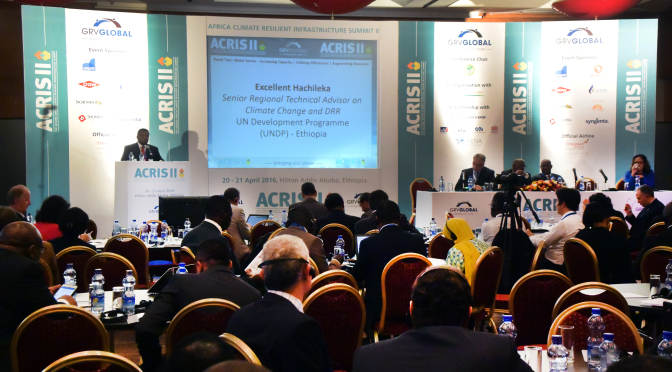
Hundreds of actors from the public and private sectors gathered in Addis Ababa last week to tackle this issue. The second annual African Climate-Resilient Infrastructure Summit brought together private, public, national and regional actors to help Africa build a climate-resilient infrastructure through strategic partnerships.

IRENA, an event partner, used the platform to meet with regional stakeholders and further work on the Africa Clean Energy Corridors. The Corridor concept, launched in 2014 for the Eastern and Southern African Power Pools, works to promote the development of renewable power and cross-border electricity trade. The initiative seeks to facilitate a steady flow of bankable renewable energy projects to attract long-term stable investments in Corridor countries. By creating a larger regional electricity market, the initiative can attract enough investment to meet 40-50% of regional power needs by 2030.
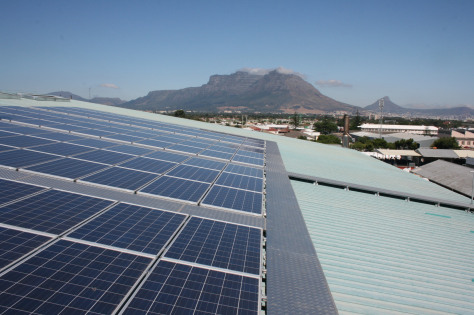
solar-panels-cape-town

Henning Wuester, Director of IRENA’s Knowledge, Policy and Finance Centre, reported on initiative progress to date:

  • The ACEC process identified high-potential zones where wind and solar plants can be developed cost-effectively. These zones are now being used in national and regional power planning: Swaziland is using the zones to develop a more integrated national energy master plan; Zimbabwe plans to hold renewable energy auctions guided by the zoning results.
  • Based on the zoning results, IRENA is working with key stakeholders to develop renewable energy projects that could be taken into consideration in the updating of the pan-African Programme for Infrastructure Development in Africa (PIDA), which currently includes only fossil fuels and large-hydro projects.
  • The ACEC initiative is helping develop and apply national and regional regulatory instruments to establish a regional power market in Southern Africa. Namibia, Tanzania, and Zimbabwe are pilot countries.
  • Projects originating from the Corridor initiative could be further supported by the Sustainable Energy Marketplace. The platform facilitates project initiation, development and financing through online matchmaking. It already contains some 50 projects in Africa and more than 20 financing instruments and facilities.

IRENA is now working with West African countries and regional bodies to expand the Corridor concept to include West Africa.

“Through the Corridor initiative, we can create a large regional market and renewable investment opportunities that can lower the cost of financing and change the future trajectory of African energy. This will help the continent achieve low-carbon economic growth and build resilience to future climate impacts.” – Henning Wuester

For more information on the Corridor initiative email [email protected]
 

The Real Cost of Energy: Why Renewables Make More Sense

Op Ed by IRENA Director-General Adnan Z. Amin (originally published in the Huffington Post)

Energy-related greenhouse gas emissions have plateaued for the second year running – an extraordinary fact considering the global economy grew by more than 3% in the same period. This news, coming just before leaders from 175 countries gathered in New York to sign the Paris Agreement, provides a welcome sign of real progress in the fight against climate change.

But stabilizing energy-related emissions is not enough to fulfil the ambition of the Paris Agreement – the kind of ambition needed to avoid the worst impacts of climate change. This will require using energy more efficiently, and transitioning rapidly (roughly six times faster than today’s pace) to an energy system powered by renewables. IRENA recently released the second edition of its Roadmap for a Renewable Energy Future (REmap) which provides recommendations on how to do just that.

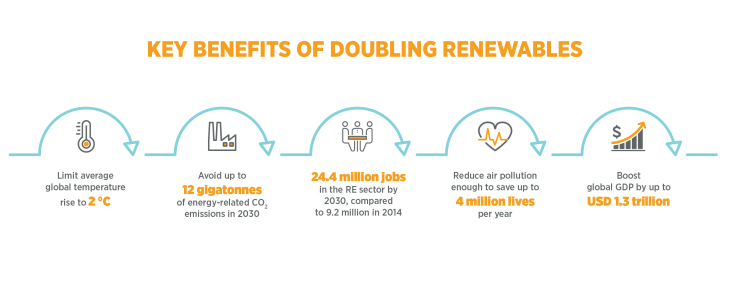
The research shows that accelerating the deployment of renewables on a scale needed to keep global temperature rise at or below 2°C is both technically feasible and economically affordable, with many additional benefits for health, economic growth and employment. In fact, doubling the share of renewable energy globally would save between $1.2 and $4.2 trillion per year thanks to avoided expenditures on climate change and air pollution. These savings are 4 to 15 times larger than the cost of deployment. In economic terms these savings would amount to between 0.9% – 3.3% of global GDP in 2030.

But governments must do two key things to achieve this doubling:

1. Ensure energy prices reflect real costs

There is a persistent misperception that renewable energy is costly. Quite apart from the fact that renewable energy costs are coming down rapidly, energy prices do not actually reflect its real costs to society.

Indoor and outdoor air pollution caused by the burning of fossil fuels is killing millions of people worldwide. In Europe, where 600,000 people suffered from air pollution-related disease or premature death in 2010, societal costs were estimated at $1.6 trillion.

There are also other heavy costs associated with fossil fuels and nuclear power that do not apply to renewable energy: oil spills; climate change impacts; radioactive waste storage and disposal; and ocean acidification for example.

Yet none of these costs are factored into the price we pay for energy – instead, we pay for them with our tax dollars, through our health insurance premiums, and with the degradation of our public lands and seas.

If energy prices were to reflect its true costs, there is no question that renewables would consistently be the least expensive option. And this is even before factoring in the positive macroeconomic benefits of renewables, such as higher economic growth, new job creation and trade advantages.

2. Let the private sector do its job

There is another persistent perception that renewable energy investments are risky.

Governments can reduce the risk by letting the private sector do its job: by passing laws, policies and regulations which provide a fair, stable and predictable investment environment.

For example, they could level the playing field between subsidies for renewables on the one hand, and fossil fuels and nuclear power on the other. Since 2009, governments have been working to phase out fossil fuel subsidies, with some success. But even today, four dollars are spent to subsidize the consumption of fossil fuels for every one dollar spent to subsidize renewable energy. With oil, gas and coal prices currently at historic lows, it is now easier than ever for governments to correct this problem.

There are many other policies which would spur the accelerated deployment of renewable energy. Enshrining renewable energy targets in law, streamlining planning procedures, and/or introducing carbon pricing or taxation at a level which reflects true costs are options that would send a powerful market signal to investors.

The fact remains that stabilizing emissions alone is not enough. If we are to meet our social, economic, environmental and development goals, we must remove the remaining barriers to renewable energy deployment and quickly accelerate the energy transition already underway.

Celebrating 5 Years of Renewables

Today marks the 5th anniversary of IRENA’s formal creation as a fully-fledged intergovernmental organization. To commemorate this occasion, IRENA is celebrating renewable energy successes over the past five years, while pushing to accelerate the ongoing energy transition.

GET INVOLVED:

Tweet your #REthenandnow story

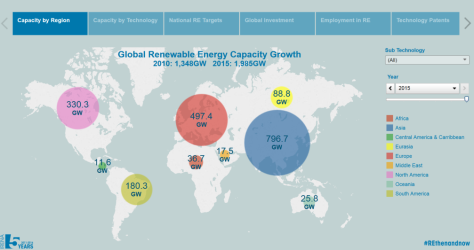
During the month of April, share your facts/figures/statistics/experiences of how renewable energy has grown over the past 5 years using the hashtag #REthenandnow. If you don’t have your own example, use one from IRENA’S 5th anniversary data dashboard.

Sample Tweets (and some infographics to share):

  • # of countries w/ renewables targets increased from 73 in 2010 to 164 in 2015 #REthenandnow
  • Global renewables investment increased from $239B in 2010 to $286B in 2015 #REthenandnow
  • Installed renewables capacity increased from 1.3TW in 2010 to 2TW in 2015 #REthenandnow
Capture
Screenshot from REsource, IRENA’s online renewable energy knowledge portal

Submit your renewable energy photos and win a trip to Abu Dhabi!

IRENA invites you to help celebrate its 5th anniversary by participating in a photography competition demonstrating the promise and power of renewable energy as the solution to a wide range of global, national and local challenges. These challenges include but are not limited to: climate change; energy security; energy poverty; health impacts from air, water and soil pollution; and community empowerment.

Competition entries should be thought-provoking, surprising, beautiful, dramatic, or entertaining – and hopefully all of the above!

Entries will be judged by a jury based on the following criteria:
+ Tells a compelling story about renewable energy solutions
+ Originality and artistic merit
+ Quality of the photo
+ Dramatic impact

The first place winner will receive an all-inclusive trip to Abu Dhabi at the time of the seventh session of the IRENA Assembly and the World Future Energy Summit (WFES) in January 2017. DEADLINE 4 September, 2016.

5IRENA_PHOTO_BUTTON-12

Doubling Renewables Can Save Trillions

By Dolf Gielen – Director of IRENA’s Innovation and Technology Centre

In the race to fuel our ever-developing world, renewable energy is making some impressive gains against fossil fuels.

While coal use continues to decline in China and around the world, renewables are growing at an unprecedented pace. Renewable energy drew a record $280 billion of investment in 2015, and more new renewables capacity is being installed each year than new fossil-based and nuclear power combined.

Meanwhile, the CEO of Canadian Pacific Railway believes fossil fuels are “probably dead” and oil and gas giants are fighting security fraud and racketeering charges for their stance on climate change.

Despite this recent sprint towards renewable energy, there is still a marathon left to run. Renewable energy, in terms of total final energy consumption, is growing at a rate of .17% per year. To double the share of renewables in the world’s energy mix by 2030 – and in doing so achieve international climate and development targets – this rate of growth must increase six-fold, to 1% per year.

So how do we do this? A new report from IRENA provides an in-depth perspective on the energy transition in 40 economies, representing 80% of global energy use. It offers concrete technology options and outlines solutions and action areas to accelerate renewable energy growth.

REmap: Roadmap for A Renewable Energy Future, finds that doubling renewables in the global energy mix by 2030 is feasible and actually less expensive than not doing so. It can save up to $4.2 trillion annually by 2030 – 15 times more than the costs – all while achieving numerous economic, social and environmental goals.

Remap_2016_Infographics_BENEFITS-02.jpeg

While great strides have been made to increase renewables in the power sector – which is on track to generate roughly 30% of the world’s electricity by 2030 (up from 23% today) – more action is needed to increase renewables in transport (i.e electric cars) and in buildings and industry (i.e. heating and cooling) as these sectors are lagging behind.

The REmap report helps map the course the global community must run to scale up renewables in the next 14 years. Now policy makers and governments must take the required action to move to speed up the energy transition and finish the race in time.

Full report

“The age of renewable energy is here, but without concerted efforts, its potential will not be reached fast enough to meet international climate and development targets. For decision makers in the public and private sectors alike, this roadmap sends an alert – both on the opportunities at hand and on the costs of not taking them.” – IRENA Director-General Adnan Z. Amin

China’s Water Crisis: Renewables Offer Water Stress Solution

Water in China is a big issue.

According to the United Nations, China is home to 21% of the world’s population but contains only 7% of global freshwater supplies. Faced with an imminent water supply challenge, China introduced province-level water use quotas for 2015, 2020 and 2030, targeting improvements in water use efficiency across sectors, and rightly so.

The country’s water tables have dropped roughly one meter per year in the north where nearly half of the people live. The north is also home to more than half of national thermal power generation, four-fifths of coal production and reserves, and nearly half of China’s sown cropland, creating competition for limited water resources.

Rapidly expanding thermal power generation is increasingly placing strains on water resources, with the power sector already accounting for 12% of total water withdrawals. With domestic electricity demand expected to rise 65% by 2030, less water-intensive solutions are needed.

Enter renewable energy.

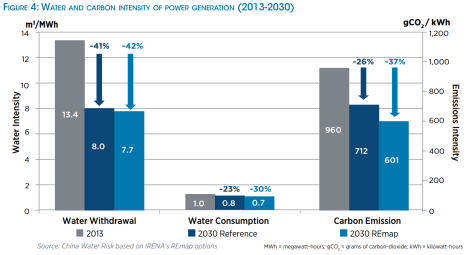
A new brief by IRENA and China Water Risk finds that scaling up renewable energy and introducing improved plant cooling technologies in China’s power sector can reduce water-intensity up to 42%.

“The global issues of water, energy and climate are completely interconnected. The only effective, immediately available solution to meet the rising demand for energy while limiting environmental impacts, is to scale up renewable energy. China has recognised this and must continue its leadership in the global energy transition.” IRENA Director-General Adnan Z. Amin.

The brief examines the expected impact of China’s power sector on water and climate in 2030. It finds renewable energy is crucial to not only decarbonise the sector, but also to realise dramatic water-related benefits for the country.

China has pledged to reduce carbon emissions by sourcing roughly 20% of primary energy consumption from non-fossil fuels by 2030. IRENA analysis finds that achieving a 26% share or renewables in primary energy supply is both technically and economically feasible. Doing so would not only reduce emissions-intensity of power generation by 37% but also reduce water-intensity by 42% thanks largely to the water saving potential of solar PV and wind.

123

During power-generation, solar PV requires far less water than thermal to produce the same amount of electricity. Wind power requires no water.

Renewable energy offers benefits well beyond just emission reductions. For China, scaling up renewables can not only meet climate goals, it can also help meet future energy demand sustainably while leaving more water for people and agriculture.

More on renewables, water and energy.

Thought Leaders Talk Renewable Energy Solutions, Innovation and Action at Fourth Annual IRENA Financial Times Event

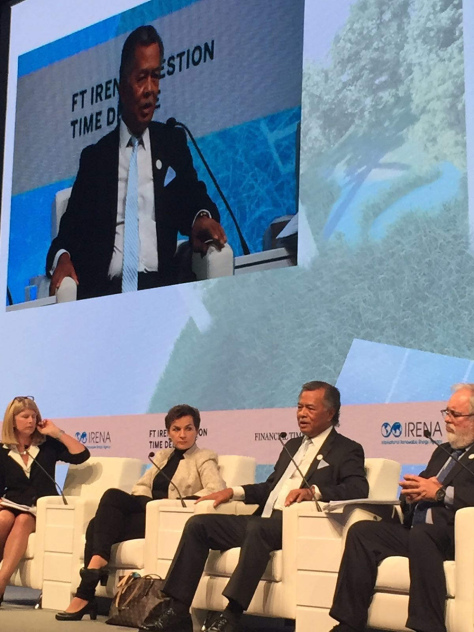
Over 500 leaders from government, business and civil society gathered yesterday at the headquarters of IRENA to discuss scaling up renewable energy as the cornerstone of global climate change mitigation. For the fourth consecutive year, the Financial Times-IRENA Question Time Debate provided a unique opportunity to discuss the international renewable energy agenda following the conclusion of IRENA’s annual Assembly.

Some notable quotes from the event:

“If we are going to decarbonise to remain below 2 centigrade, it requires the transformation of economies, energy systems, the way we do business and even our lifestyles.”Adnan Z. Amin, IRENA Director-General

Newsroom_FT2From left to right: Pilita Clark, Environmental Correspondent, Financial Times; Christiana Figueres, Executive Secretary, UNFCCC; Henry Puna, Prime Minister, Cook Islands; Miguel Arias Cañete, European Union Commissioner for Climate Action & Energy

“Policy makers must develop stable, practical regulations. If the framework is not there, investment will not follow.” – Miguel Arias Cañete, European Union Commissioner for Climate Action & Energy

“We have a goal of 100% renewables by 2020 and we’re on course to achieve that. We will be at 80% by next year.” – Henry Puna, Prime Minister, Cook Islands

“One of the obstacles is market distortion – there are certain oil subsidies and other regulatory policies from legacies that incentivise generation models.”- Kyung-Ah Park, Head of Environmental Markets Group, Goldman Sachs, on obstacles to renewable energy deployment

“This is not for the light of heart, it’s a battle, but we are going to win. We have drawn the boundary around what we are going to emit. By the year 2050, we will have a global economy that is down to net zero.” Christiana Figueres, Executive Secretary, UNFCCC

“We can no longer burn our way into global prosperity. We all know that renewable energy is limitless and will last forever, offers us security and peace of mind. We should have everyone on board for shared prosperity. Events like this are vital to spread the word.” – Ban Ki-moon, United Nations Secretary-General

Newsroom_FT3Ban Ki-moon, United Nations Secretary-General

The event took place immediately following the conclusion of the sixth IRENA Assembly, which brought together more than 1,000 energy leaders from 150 countries to set the global renewable energy agenda and make concrete steps to accelerate the ongoing global energy transition.

Newsroom_FT6Panellist Kyung-Ah Park, Head of Environmental Markets Group, Goldman Sachs
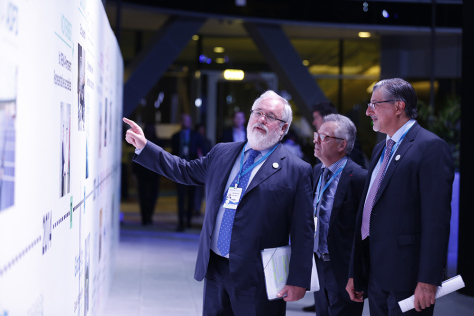
Newsroom_FT5Panellist Miguel Arias Cañete, European Union Commissioner for Climate Action & Energy, looking at the IRENA history timeline at IRENA headquarters
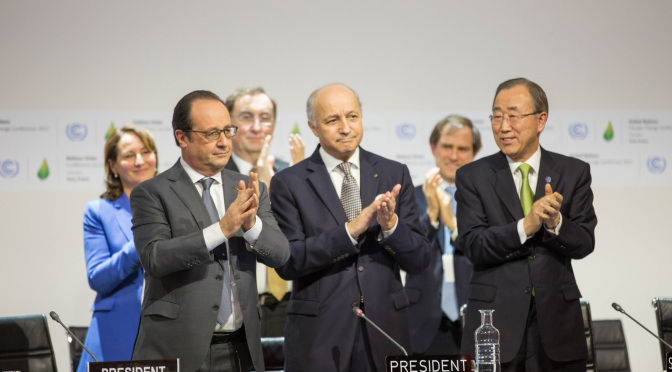
More on the event: https://live.ft.com/Events/2016/FT-IRENA-Question-Time-Debate-2016

Event photos: https://www.flickr.com/photos/irenaimages/albums/72157661038902124

IRENA Welcomes Paris Climate Agreement as ‘watershed for the global energy transition’

IRENA Director-General Adnan Z. Amin issued the following statement after the adoption of the Paris Agreement at the COP21 Climate Conference:

“Yesterday the global community was united in voicing commitment for decisive, inclusive and coordinated action on climate change. The Paris Agreement provides a framework for international cooperation and sends a clear signal to all stakeholders to raise their ambition.

“The innovative approach of the Conference incorporated all of the ingredients for a positive outcome, setting the stage for decisive action moving forward. The Agreement establishes long-term vision for the deep reduction of global emissions and the imperative of decarbonising energy. The commitments submitted by countries in their Intended Nationally Determined Contributions demonstrate the centrality of renewable energy in national strategies. And the bold announcements made by private sector and other actors strengthened the meeting’s solution-focused theme.

“IRENA welcomes the Paris Agreement as a watershed for the global energy transition. Renewable energy has made remarkable progress in the last decade. Combined with energy efficiency, it provides an immediate, viable and affordable solution to the challenge of climate change. But to meet the ambition set forth in the Agreement, accelerating the deployment of renewable energy across all sectors must start now. In January 2016, we will welcome global energy leaders at the 6th Session of the IRENA Assembly to move the Paris Agreement to the next phase, setting the global renewable energy agenda and establishing a blueprint for action to meet climate goals and set the world on a path to a sustainable energy future.”