

Less than 2% of today’s global electricity is generated by solar photovoltaics (PV), but this is set to change. According to an IRENA report released today at InterSolar Europe, this figure could grow to 13% by 2030. Letting in the Light: How Solar Photovoltaics Will Revolutionize the Electricity System finds the solar industry is poised for massive expansion, driven primarily by cost reductions. It estimates that solar PV capacity could reach between 1,760 and 2,500 gigawatts (GW) by 2030, up from 227 GW today. Continue reading Solar Energy Could Power 13% of the World by 2030
Tag Archives: jobs

8.1 Million People Now Work in Renewables, New Study Finds
More than 8.1 million people worldwide are now employed by the renewable energy industry – a 5% increase from last year – according to a report released today by IRENA at its 11th Council meeting. The report, Renewable Energy and Jobs – Annual Review 2016, also provides a global estimate of the number of jobs supported by large hydropower, with a conservative estimate of an additional 1.3 million direct jobs worldwide.
IRENA’s Director-General Adnan Z. Amin noted today that this growth is significant given that it stands in contrast to trends across the broader energy sector; the total number of renewable energy jobs worldwide rose in 2015 while jobs in the broader energy sector fell. In the US for example, renewable energy jobs increased 6% while employment in oil and gas decreased 18%. Likewise in China, renewable energy employed 3.5 million people, while oil and gas employed 2.6 million. Continue reading 8.1 Million People Now Work in Renewables, New Study Finds
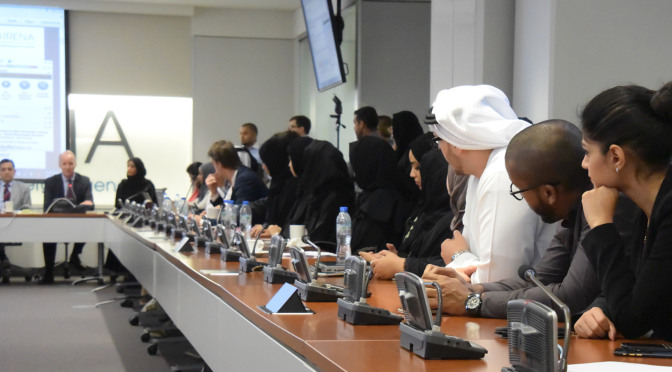
Renewable Energy: A Smart Career Choice
More than 50 members of Masdar Institute’s Young Future Energy Leaders (FYEL) programme were introduced today to the rigors of analyses in the fast-growing US$270-billion renewable energy sector.
The IRENA-hosted one-day course, titled ‘Being an analyst in the renewable energy industry,’ was led by officials from Masdar and IRENA, with representatives of PricewaterhouseCoopers, the International Energy Agency, and the World Bank joining the panel discussion. Experts highlighted their day-to-day activities and responsibilities as analysts and offered advice on tools and data sources that could help develop YFEL members into full-fledged industry analysts.
Over the past three years, more new renewable energy capacity has been installed than new capacity in fossil and nuclear power combined. Today, more than 7.7 million people worldwide are employed by the renewable energy sector, which has grown 17% since last year. IRENA expects this number could top 16 million if we succeed in doubling the global share of renewables by 2030.
“Energy markets worldwide are undergoing a rapid transformation, including the emergence of renewable energy as a mainstream alternative to fossil fuels. Government and business must track these changes for policy and planning purposes, and they will need skilled energy analysts to do so. IRENA is pleased to work with Masdar Institute’s YFEL program to help meet the growing need for future energy experts.” – Adnan Z. Amin, IRENA Director-General
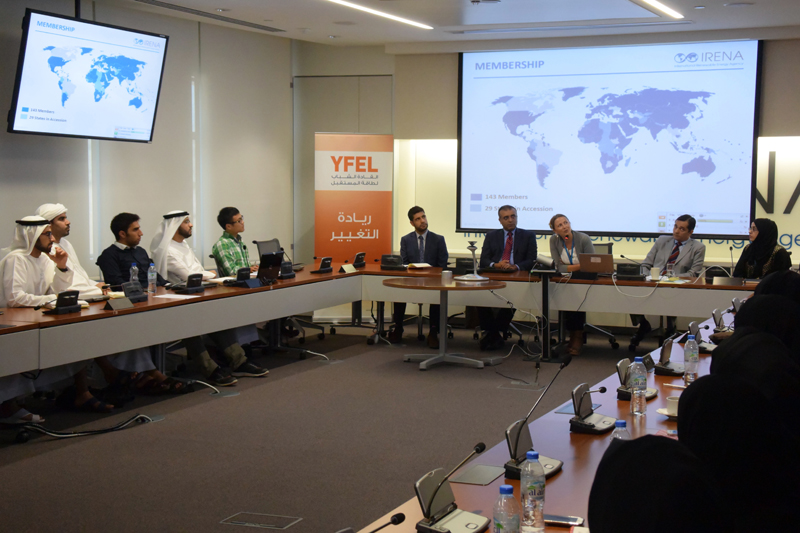
Participants were introduced to IRENA’s REsource, a search engine on all things renewable energy; the Global Atlas, the most comprehensive mapping tool for global renewable energy potential; IRENA/IEA’s joint renewable energy policies database; renewable energy costs data, and the IRENA Community, a networking site on all things renewable energy.
In addition to courses organized by external partners, YFEL offers guest lectures and intensive courses annually on technology, policy, and leadership that are led by renowned industry experts and Masdar Institute faculty.
The YFEL programme seeks to inspire, engage and empower bright young people to be tomorrow’s leaders in the field of alternative energy and sustainability. It brings together students and promising young professionals from the UAE and around the world to series of networking, skill development and idea sharing forums focused on this dynamic and vitally important field.

Solar Impulse Lands in Hawaii, Breaks World Record for Longest Flight
At 5:55 in the morning, the Solar Impulse 2 safely landed in Kalaeloa, Hawaii, and, along the way in the blue expanse of the Pacific Ocean, shattered the world record for the longest non-stop solo flight in any kind of plane. It is a historic first for solar energy, further proving the potential of renewable energy to power a clean, sustainable future. IRENA is proud to be a partner of Solar Impulse and its mission to demonstrate the possibilities of renewable energy.
The Solar Impulse 2 aircraft, piloted alternately by Swiss explorers Bertrand Piccard and Andre Borschberg, set off on its 22,000-mile journey around the world from Abu Dhabi on 9 March. It will end its epic journey back in Abu Dhabi sometime in late 2015, weather permitting.
“No solar plane has ever flown for this long and we’re pushing the plane and pilot to their limits: fatigue, aircraft systems and energy management.”- Bertrand Piccard, Solar Impulse Pilot
At 76h 45min into the flight from Japan to Hawaii, the Solar Impulse broke Steve Fossett’s 2006 record for the longest solo flight in a plane, but there were other barriers to clear. Throughout the flight, the pilots had to cope with weather fronts, which forced them to maintain holding patterns and stay awake overnight.
After nearly five days of flying, the plane safely touched down during sunrise in Hawaii.
Watch the landing video:
“I feel exhilarated by this extraordinary journey. I have climbed the equivalent altitude of Mount Everest five times without much rest…This success fully validates the vision that my partner Bertrand Piccard had…to reach unlimited endurance in an airplane without fuel.” – Andre Borschberg, Solar Impulse Pilot
On IRENA’s partnership with Solar Impulse:
“By collaborating with Solar Impulse, IRENA reaffirms the importance of innovation and technology in achieving a cleaner, more secure, less volatile, global energy system. The project is truly emblematic of the type of pioneering spirit and innovation we are currently witnessing in the field of renewable energy. Its success is a testament to the fact that governments and the private sector are realizing just how much can be achieved through renewable energy deployment.” IRENA Director-General Adnan Z. Amin
Overall, the Solar Impulse’s trip around the globe is expected to take 25 flight days and is broken into 12 legs at speeds between 30 and 60 miles per hour. Its next destinations are from Hawaii to Phoenix and then New York, Europe and back to Abu Dhabi. The aircraft’s wingspan is longer than that of a jumbo jet, but it weighs only 2.3 tonnes — about the same as a car.
Piccard’s vision of an airplane flying day and night with no fuel has now become reality. If the world utilized the clean technologies similar to those used in Solar Impulse 2 today, energy consumption and CO2 emissions would be halved. Furthermore, these technologies are cost-competitive, support overall economic growth and create jobs.
Follow the Solar Impulse as it continues its journey with live updates.
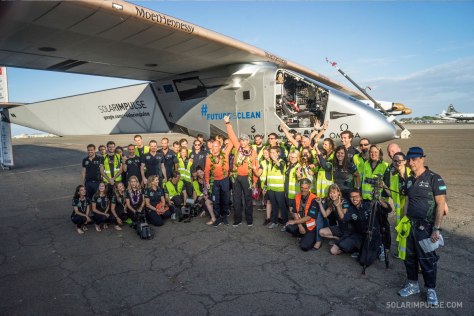
The Solar Impulse team

Star Power Lends Weight to Sustainable Energy for All
Providing clean, sustainable energy to the 1.1 billion people currently without modern energy services now has a new champion; a champion with a loud voice and global reach. Akon, R & B star and founder of the Akon Lighting Africa initiative teamed up with Sustainable Energy for All (SE4All) this week in New York, lending his voice to the cause and participating in the second annual SE4All forum.
On the sidelines of the forum today, SE4All and Akon held a press conference to underscore the importance of universal energy access. Joining Akon on the panel were Adnan Amin, Director-General of IRENA, Kandeh Yumkella, Special Representative of the Secretary-General and CEO of Sustainable Energy for All, Neven Mimica, EU Commissioner for International Cooperation and Development, and Sheila Oparaocha, head of Energia.
Akon stressed that energy access is key to helping people escape poverty, increasing quality of life and improving health. He also stated that he wanted to give back to the people of Africa by bringing them light through the Akon Lighting Africa initiative.

In its role as the SE4All Renewable Energy Hub, IRENA developed the Global Renewable Energy Roadmap (REmap 2030), which explores pathways to double the share of renewables in the global energy mix by 2030. The roadmap examines how renewable energy could support SE4ALL’s other objectives of achieving universal access to modern energy services, and doubling the rate of energy efficiency improvements.
In 2013, REmap 2030 looked at 26 countries accounting for 75% of global energy use, and examined how much they could realistically increase the share of renewable energy in their energy mix by 2030. It found that it is entirely possible to double the global share of renewables, up to 36%, and is actually cheaper than not doing so, when you take into account externalities like the cost of health care, pollution etc.
Fast forward to today and the socio-economic case for renewable energy is even stronger.
An IRENA report released earlier this year found that the cost of generating power from renewable energy sources has reached parity or dropped below the cost of fossil fuels for many technologies in many parts of the world. Onshore wind is now one of the most cost-competitive sources of electricity available with some projects now delivering electricity for as little as US 4 cents per kWh.
These lows costs for renewables are triggering increased deployment and creating jobs. Just yesterday, IRENA released the 2015 renewable energy and jobs annual review, which found that 7.7 million people worldwide are now employed by the renewable energy sector. This is an 18% increase in the last year and a 35% increase in the last two years.
If we succeed in doubling the global share of renewable energy, which REmap showed us in entirely possible, then we will surpass 16 million jobs by 2030.
With these developing realities in play, a SE4All future of 100% electrification is indeed possible.
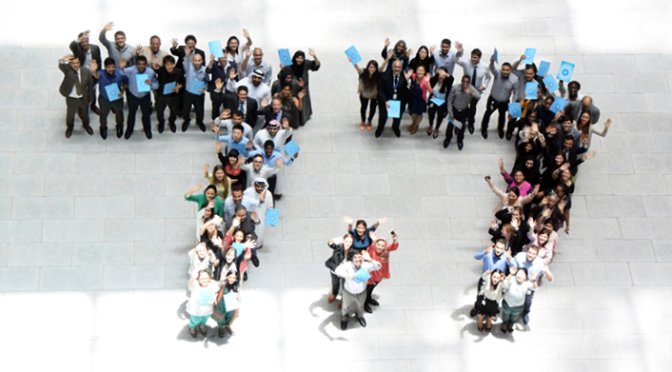
7.7 Million People Worldwide Are Employed by Renewable Energy: New IRENA Report
According to a report being released today by IRENA, more than 7.7 million people worldwide are now employed by the renewable energy industry. This is an 18 per cent increase from last year’s figure of 6.5 million. IRENA will present the findings of its new report at the second annual UN Sustainable Energy for All Forum, during the plenary session on 19 May.
The report, Renewable Energy and Jobs – Annual Review 2015, also provides a first-ever global estimate of the number of jobs supported by large hydropower, with a conservative estimate of an additional 1.5 million direct jobs worldwide. As in previous years, renewable energy employment is shaped by regional shifts, industry realignments, growing competition and advances in technologies and manufacturing processes. Jobs in the renewable energy sector are increasingly being created in Asia.
“We are seeing the widest spread of employment through renewable energy this year. Five of the 10 countries with the most renewable energy jobs are now located in Asia: China, India, Indonesia, Japan, and Bangladesh.” – IRENA Director-General Adnan Z. Amin
As a result, even with continued jobs growth, the European Union and the United States now represent 25 per cent of global renewable energy jobs, compared to 31 per cent in 2012.
“Here in the United States, a country fast becoming a leader in renewable energy innovation, we are seeing a rapid rise in deployment of solar PV in particular, along with strong investment in wind in several states and a leading focus on development of advanced biofuels. Overall, wind jobs in the US have increased by almost half – 43% – since last count to 73,000, whilst total solar employment surged 22% to 173,800 in 2014. We have also found that the employment of women in the US solar industry is on the rise, increasing from 26,700 to 37,500 last year.” – IRENA Director-General Adnan Z. Amin
The 10 countries with the largest renewable energy employment figures are: China, Brazil, the United States, India, Germany, Indonesia, Japan, France, Bangladesh and Colombia. The solar PV industry is the largest renewable energy employer worldwide with 2.5 million jobs, followed by liquid biofuels with 1.8 million jobs, and wind power, which surpassed one million jobs for the first time this year. The employment increase spreads across the renewable energy spectrum with solar, wind, biofuels, biomass, biogas and small hydropower all seeing increases in employment.
For renewable energy employment to continue to grow, supportive policies should be used.
“In order to maximise job creation from renewable energy deployment, governments need to implement a mix of cross-sectoral policies that encourage deployment, stimulate investment in local industries, strengthen firm-level capabilities and promote education and research.” – Rabia Ferroukhi, IRENA Deputy Director, Knowledge, Policy and Finance Centre
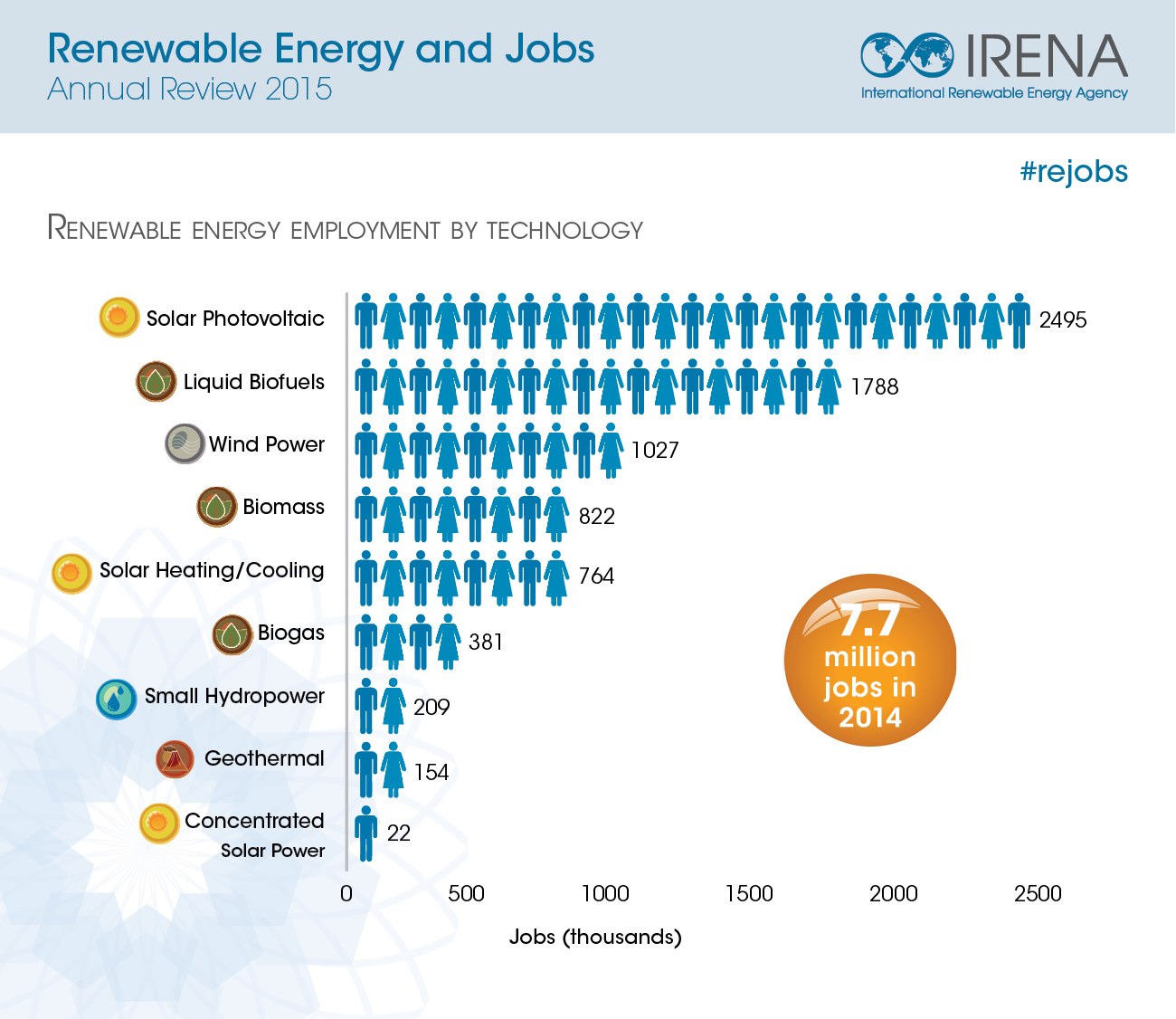
Infographic on number of renewable energy jobs per technology (thousands)
Download the full Renewable Energy and Jobs – Annual Review 2015
