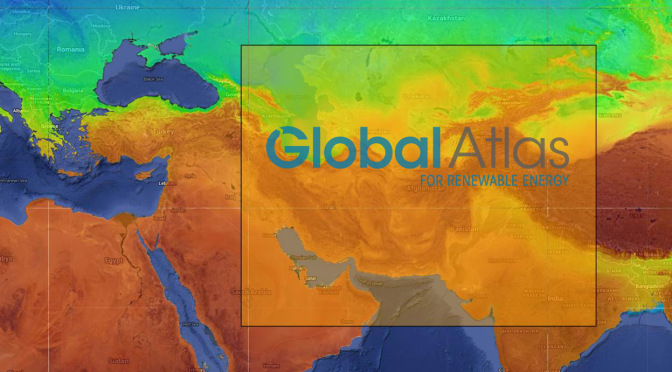
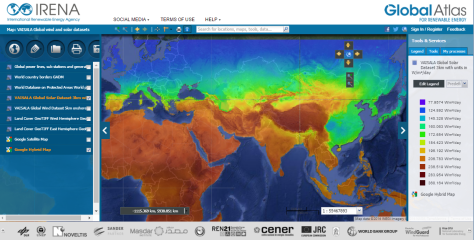
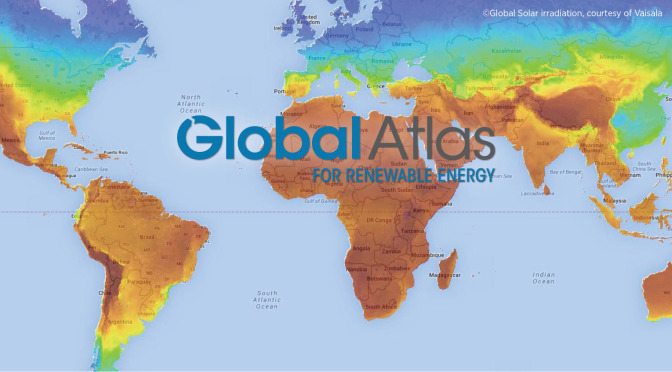
For the first time, privately-produced renewable energy resource data is available for download to all for free. This past May, IRENA’s Global Atlas for Renewable Energy unveiled a new feature that allows users to download renewable resource data from selected datasets for offline analysis. Up to now, only data from selected publicly-funded sources was available. This has changed now that Vaisala, a global leader in environmental and industrial measurement, has made its average annual data on solar irradiation and wind speeds available for download through the Global Atlas. This capability gives developers, policy makers, and researchers access to globally consistent resource data that can be used in setting policy and performing initial project planning and prospecting.
The Vaisala map in the Global Atlas provides access to global solar irradiation and global wind speeds
Less than 2% of today’s global electricity is generated by solar photovoltaics (PV), but this is set to change. According to an IRENA report released today at InterSolar Europe, this figure could grow to 13% by 2030. Letting in the Light: How Solar Photovoltaics Will Revolutionize the Electricity System finds the solar industry is poised for massive expansion, driven primarily by cost reductions. It estimates that solar PV capacity could reach between 1,760 and 2,500 gigawatts (GW) by 2030, up from 227 GW today. Continue reading Solar Energy Could Power 13% of the World by 2030→
Today, IRENA launched a new version of the Global Atlas for Renewable Energy, the online renewable energy mapping platform. For the first time, the platform allows users to download resource data for offline analysis, and to print and export map images.
With these enhancements, the Global Atlas now offers a complete suite of services to support renewable resource mapping and assessment, including an online GIS interface, datasets for five renewable energy technologies that cover every country in the world, online analysis tools, and the ability to export data and maps in several different formats. Continue reading Renewable Resource Data Now Available for Free Download→
The 2016 edition of the world’s most comprehensive, up-to-date and accessible figures on renewable energy capacity have just been released by IRENA.
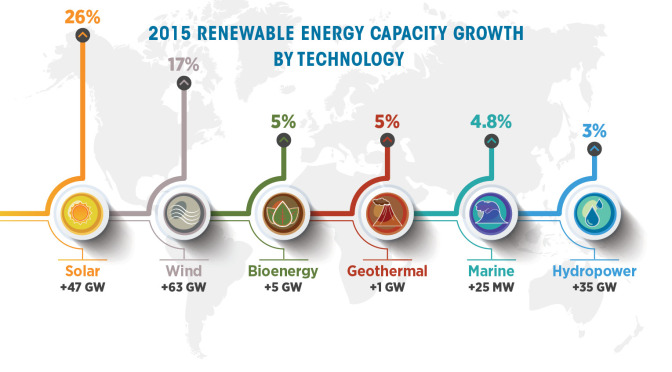
Renewable Energy Capacity Statistics 2016, which contains 13,546 data points from more than 200 countries and territories, finds that renewable power generation capacity grew 8.3% in 2015, the highest rate ever recorded. Overall, capacity has increased by roughly one-third over the last five years, with most of this growth coming from new installations of wind and solar energy. Continue reading Renewable Energy Breaks Growth Record in 2015→
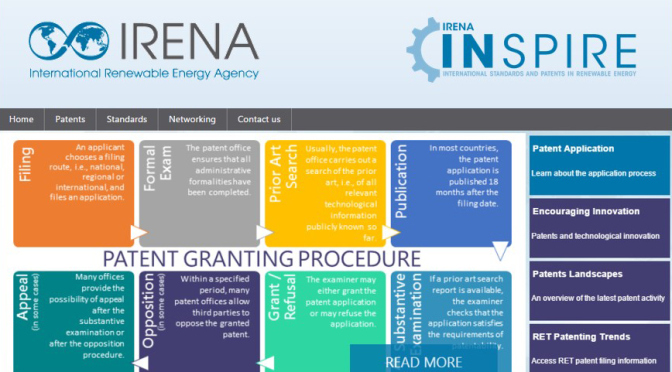
Renewable energy patents and standards provide a window into the growth and innovation taking place in the renewable energy sector. Patents show who is developing what and where, and which countries are leading the charge in which technology. International standards ensure that renewable energy technology works safely, and bring more money into the industry by boosting investor confidence.
But accessing this information has not always been an easy task, with information spread across disparate, difficult-to-use databases.
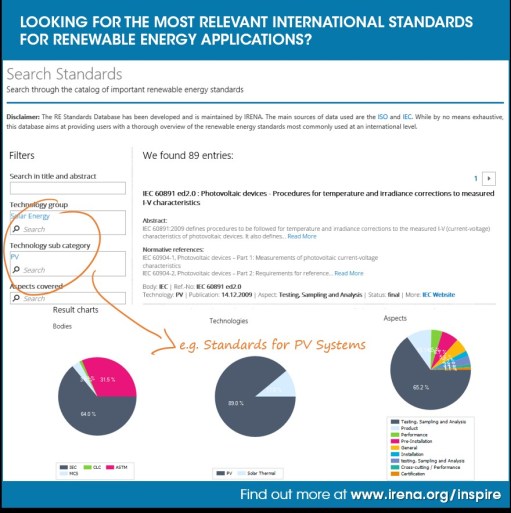
Thanks to a new online platform launched today by IRENA, policy makers and other energy sector players can now access the world’s largest collection of global renewable energy standards and patents in one place. The International Standards and Patents in Renewable Energy platform (INSPIRE), is the first and most complete solution of its kind, helping users search through, locate and analyse 400 international standards and more than 2 million patents for renewable energy technology. This consolidation fosters collaboration between innovators, spurs improvement through product comparison and helps identify partners by matching domestic energy needs to innovative energy solutions.
Thanks to collaboration between IRENA, the European Patent Office (EPO) and the International Electrotechnical Commission (IEC), the INSPIRE platform has multiple functionalities. The standards section enables users to search through a database of more than 400 internationally used standards and generate reports as needed. It also explains what standards are, how they can be used and why they are important for quality assurance, investor confidence and technology trading. The patents section contains information on over two million patent documents relating to carbon mitigation technologies from the world’s most comprehensive global patent statistics database, the EPO’s PATSTAT.
The combination of resources on INSPIRE will help users analyse various aspects of renewable energy policy and innovation. It can help indicate the effectiveness of policies to promote renewable energy innovation through the analysis of trends in patent activity. Users can also perform metadata analysis of technology trends, comparing development within, or between, different technologies. For example, the number of patents filed for renewable energy technology has increased annually by more than 20 per cent in recent years, while the average increase for other technologies is around 6 per cent.
Partner quotes:
“The INSPIRE platform demonstrates the role of the global patent system as a support for innovation in renewable energy, encouraging research and development in technologies to serve modern energy needs while addressing climate change. INSPIRE also showcases the role of patent information, which provides valuable high-level information to advise policy makers on the renewable energy sector.” – EPO President Benôit Battistelli
“By linking the technical information in IEC international standards to practical applications in renewable energy, INSPIRE will be a precious resource for energy regulators. It will assist policy makers in finding relevant international standards faster and more efficiently. It will also help educate stakeholders about the strategic role of international standards and conformity assessment for the cost-efficient expansion of renewable energy generation.” – IEC General Secretary & CEO Frans Vreeswijk
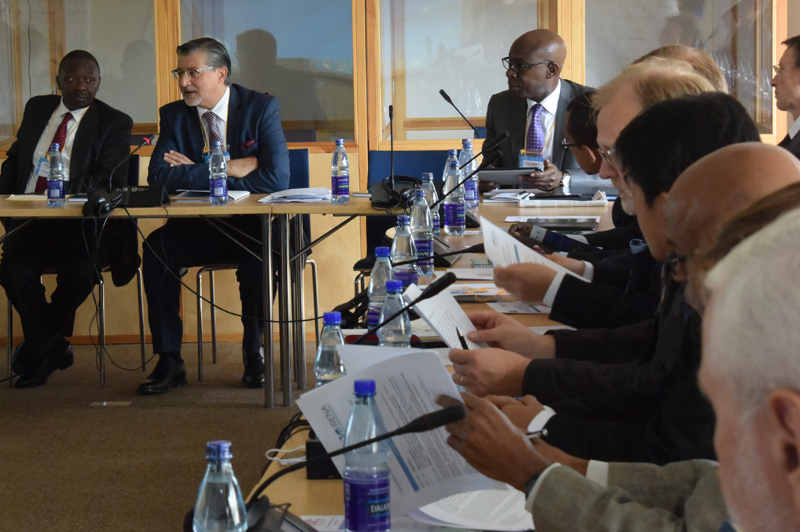
More than 70 representatives from 22 countries and 15 multilateral organizations, gathered in Nairobi this week to push forward the global expansion of geothermal energy.
Geothermal energy is reliable, predictable and can last for decades. It has a minuscule carbon footprint, is one of the lowest-cost energy sources once start-up costs are met, and can replace fossil fuels for electricity and heating thereby reducing global emissions.
Yet, this form of renewable energy is vastly untapped across the globe.
Geothermal resources have been identified in nearly 90 countries but only 24 are producing geothermal electricity. In 2013, IRENA recorded just 12 GW of geothermal capacity worldwide but its potential capacity for energy alone is 1,700 GW, as estimated by the IEA.
To gather influence and fast-track the development of geothermal energy worldwide, global leaders are combining forces to create the Global Geothermal Alliance (GGA). Introduced at the Abu Dhabi Ascent meeting in May 2014, the GGA has been gathering support and organizing itself to formally launch at COP21 in Paris.
“We have a very important opportunity before us to prominently feature geothermal energy in a global climate change platform in Paris.” – IRENA Director General Adnan Z. Amin
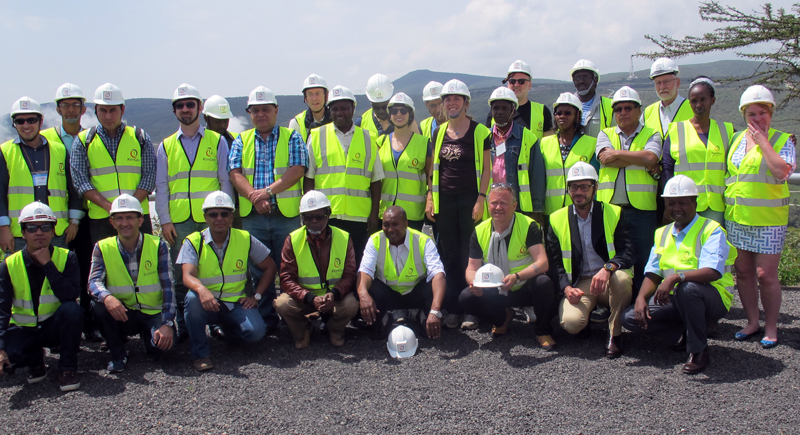
Global Geothermal Alliance Meeting, Nairobi, June 2015
More and more countries with large geothermal potential are working to make it an essential part of their energy mix. For example, Turkey has added 350 MW of geothermal capacity in the past six years and France is experiencing its most active period for geothermal investment in two decades.
This early growth must be encouraged and expanded for geothermal to reach its full global potential.
Currently, 18 countries and various multilateral organizations have joined the GGA initiative including, Bolivia, Burundi, Chile, Colombia, Costa Rica, Djibouti, Ecuador, Egypt, El Salvador, Fiji, France, Honduras, Iceland, Nicaragua, Kenya, Philippines, the United States, Turkey, the Inter-American Development Bank and the World Bank. New Zealand and Japan have also expressed interest.
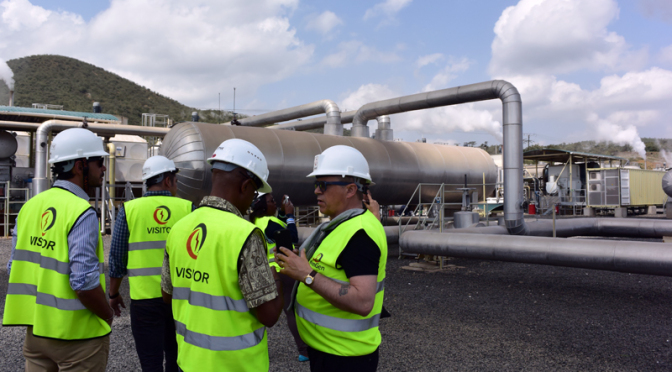
On the sidelines of the recent GGA meeting in Nairobi, attendees visited the Olkaria geothermal complex and power station, the first geothermal power plant in Africa.
Olkaria Geothermal Complex and Power Station – Kenya
Have you ever wondered what the renewable energy potential was for a region or specific location?
Today, IRENA is launching a new mobile app that can transform your mobile device into a prospector for renewable energy. The Global Atlas pocket brings reliable data on global renewable energy potential to anyone with a smart phone, for free. It’s the most advanced tool of its kind, combining 1,000 maps from 67 governments and 50 data centres to provide reliable information on renewable energy resources anywhere in the world, from major cities, to isolated islands, to remote deserts.
It allows user to screen renewable energy project sites before making investment decision, create content on clean energy potentials in areas of interest and access images of growth areas for renewable energy infrastructure opportunities. It also comes with a powerful combination of search functionalities including geolocation services, personalized search categories, map views and sharing capabilities.
See a quick tutorial:
The Global Atlas pocket is the mobile version of the online Global Atlas portal, which aims to provide access to the necessary datasets, expertise and financial support to help countries evaluate their national renewable energy potential.
The Global Atlas pocket is now available on all platforms including BlackBerry® 10, iOS, Android™ and Windows Phone®.
Download the Global Atlas pocket for free:
Windows Phone
Blackberry World
Apple iTunes
Google play
Covering the latest news from the International Renewable Energy Agency (IRENA) and developments in renewables.