
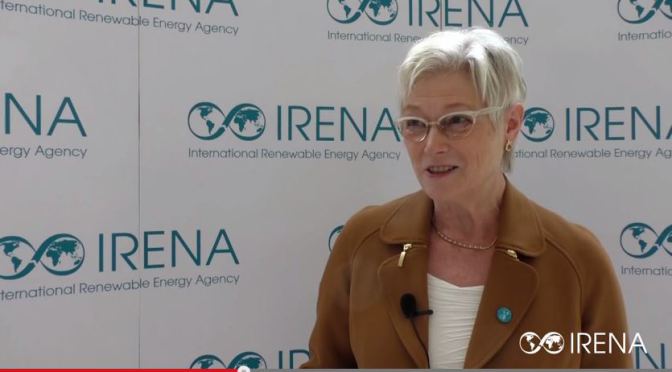
“Renewables are key for the future. By 2040 more than 50% of electricity will come from renewables, with non-hydro sources like wind and solar having the most impact.” Maria van der Hoeven – Executive Director of the International Renewable Energy Agency
Category Archives: POSTS
Renewable Energy Can Help Reach 100% Electrification
Sustainable energy is the golden thread that connects economic growth, increased social equity and an environment that allows the world to thrive.”- United Nations Secretary General Ban Ki-Moon on the launch of the Sustainable Energy for All initiative
During IRENA’s fifth Assembly today, delegates engaged in a programmatic discussion on off-grid renewable energy deployment. Four years ago, The UN launched the Sustainable Energy for All initiative to meet the goal of providing electricity to 100% of the global population by 2030. While progress has been achieved in this area, with 1.7 billion more people connected today than in 1990, there is still a long way to go.
To reach 100% electrification, the rate of electricity infrastructure expansion must double.
According to Kandeh Yumkella, Special UN Representative of the SE4All initiative speaking from the panel today, off-grid solutions, both as mini-grids and standalone systems, will provide the greater share of additional generation necessary to achieve universal electricity access within the next 15 years.
“Large fossil-fuel projects take 3-5 years to deliver electricity. Smaller, off-grid renewable energy projects can bring power to the people much faster. They must be the way forward.” – Kandeh Yumkella
Renewable energy technologies are cost-competitive, mature, modular, adaptable, secure, environmentally sustainable and accessible. IRENA’s work on costings, illustrated in a new report launched yesterday, finds that renewable energy technologies are the most cost-competitive option for electrification in many rural areas and islands. Large reductions in the cost of technology – nearly 80 percent for solar PV technology since 2008, for example – have made renewables significantly cheaper than diesel-fired generation or kerosene-based conventional lighting in off-grid areas.
26 million household are already served by off grid renewable energy, 20 million through solar home systems, 5 million through renewable energy-based minigrids and 1 million through small wind turbines.
There are still significant barriers however that countries must overcome to implement off grid systems including:
- Ideology: In order to scale up deployment, the ideology needs to move from a project to project approach, to a market-level approach with targeted incentives and enabling policies.
- Finance: We currently invest USD 9 billion a year on energy access, but USD 45 billion is needed to achieve universal access (but funds like ADFD are helping bridge this gap).
- Capacity building: Adequate training and education are needed to support local implementation and decrease independence on foreign know-how.
The session introduced a Working Paper on Off-Grid Renewable Energy Systems which outlines some of the challenges and opportunities with off grid electrification.
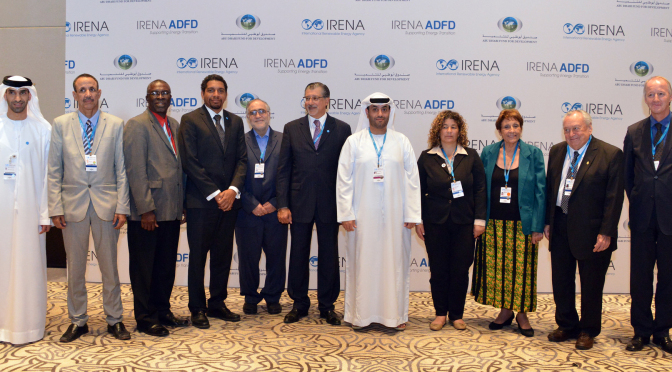
IRENA and ADFD Bring Renewable Power to 280,000 in Many Rural Communities
IRENA and the Abu Dhabi Fund for Development (ADFD) today announced USD 57 million in concessional loans for five renewable energy projects in developing countries. The projects to be financed in the second cycle have a combined total capacity of 35 megawatts, bringing reliable and sustainable power to more than 280,000 people in rural communities that lack access to modern energy services.
The loans go to projects in a geographically diverse set of countries including Argentina, Cuba, Iran, Mauritania and St. Vincent and the Grenadines.
“Renewable energy offers the prospect of clean, affordable power to the 1.3 billion people currently off the electricity grid. While renewable energy resources are abundant in many communities suffering from energy poverty, finance is still a key challenge for deployment. That is why the partnership between IRENA and ADFD is so important as a pioneering effort.” -IRENA Director-General Adnan Z. Amin
This is the second loan cycle of seven, which together will commit USD 350 million over seven years to the deployment of renewable energy in developing countries, with a total project value of an estimated USD 800 million. The funds from ADFD mobilise other funds and will lead to more than double the invested amount.
Projects approved for funding in the second loan cycle include solar, hydro, hybrid (wind and solar) and geothermal energy. The projects selected represent a mix of renewable energy sources, are innovative, potentially replicable or scalable, and will improve energy access.
“As part of its mandate to work on projects with a profound impact on the economies of developing countries, ADFD has collaborated with IRENA to support the renewable energy sector as a tool for economic and social development,” said Mr. Adel Abdulla Al Hosani, Director of Operations Department in ADFD. “Towards this priority, we are keen to support the economic development and deployment of sustainable energy projects in countries with immense clean energy potential, but lacking necessary financial resources and project management expertise.”
The IRENA/ADFD Project Facility pioneers the support of renewable energy as a viable and sustainable focus for foreign development assistance that offers long-term social and economic benefits to developing countries.
The third funding cycle of the Project Facility is now open for project proposals, with concessional loan interest rates of 1-2 per cent. These new, lower rates will support an even broader range of renewable energy projects throughout the remaining five loan cycles.
“The UAE sees renewable energy as a new cornerstone of sustainable development, with dramatic cost reductions having made it the most competitive energy option in many developing countries. The partnership between ADFD and IRENA provides a powerful way to demonstrate renewable energy’s viability and speed up further deployment.” – Dr. Thani Al Zeyoudi, the UAE’s Permanent Representative to the IRENA and Director of Energy and Climate Change at the Ministry of Foreign Affairs
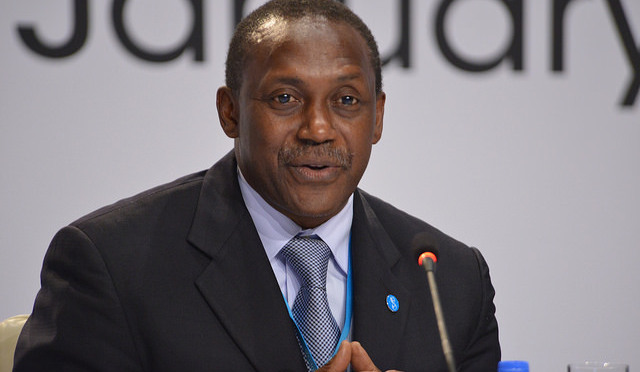
Interview: Kandeh Yumkella Talks to IRENA About the Future of Renewable Energy
“I see the future of renewable energy as very promising…” Kandeh Yumkella
Renewable Power Costs Plummet: Many Sources Now Cheaper than Fossil Fuels Worldwide
The cost of generating power from renewable energy sources has reached parity or dropped below the cost of fossil fuels for many technologies in many parts of the world, IRENA revealed in a new report today.
The landmark report, Renewable Power Generation Costs in 2014, concludes that biomass, hydropower, geothermal and onshore wind are all competitive with or cheaper than coal, oil and gas-fired power stations, even without financial support and despite falling oil prices. Solar photovoltaic (PV) is leading the cost decline, with solar PV module costs falling 75 per cent since the end of 2009 and the cost of electricity from utility-scale solar PV falling 50 per cent since 2010.
“Renewable energy projects across the globe are now matching or outperforming fossil fuels, particularly when accounting for externalities like local pollution, environmental damage and ill health. The game has changed; the plummeting price of renewables is creating a historic opportunity to build a clean, sustainableenergy system and avert catastrophic climate change in an affordable way.” – Adnan Z. Amin, Director-General of IRENA
Report highlights:
- In many countries, including Europe, onshore wind power is one of the most competitive sources of new electricity capacity available. Individual wind projects are consistently delivering electricity for USD 0.05 per kilowatt-hour (kWh) without financial support, compared to a range of USD 0.045 to 0.14/kWh for fossil-fuel power plants.
- The average cost of wind energy ranges from USD 0.06/kWh in China and Asia to USD 0.09/kWh in Africa. North America also has competitive wind projects, with an average cost of USD 0.07/kWh.
- Solar PV module prices have dropped 75% since 2009 and continue to decrease.
- Residential solar PV systems are now as much as 70% cheaper than in 2008.
- Between 2010 and 2014 the total installed costs of utility-scale solar PV systems fell by as much as 65 per cent. The most competitive utility-scale solar PV projects are delivering electricity for USD 0.08/kWh without financial support, and lower prices are possible with low financing costs. Their cost range in China, North America and South America has fallen within the range of fossil fuel-fired electricity.
- Solar power prices are dropping rapidly in the Middle East, with a recent tender in Dubai, UAE, falling to 0.06USD/kWh.
- Renewables are competitive, even when integrating high shares of variable renewables into the electricity. When damage to human health from fossil fuels in power generation is considered in economic terms, along with the cost of CO2 emissions, the price of fossil fuel-fired power generation rises to between USD 0.07 and 0.19/kWh.
For 1.3 billion people worldwide without electricity, renewables are the cheapest source of energy. Renewables also offer massive gains in cost and security for islands and other isolated areas reliant on diesel.
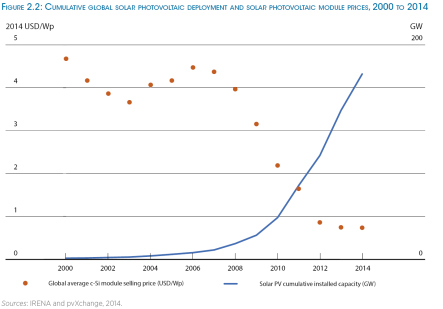
Thanks in large part to the clear business case for renewables, a record high of 120 gigawatts of renewable energy was added to the global energy mix in 2013, with similar additions forecast for 2014. Renewable energy accounted for 22 per cent of global electricity generation and 19 per cent of total final energy consumption in 2013.
“Now is the time for a step-change in deployment for renewables. It has never been cheaper to avoid dangerous climate change, create jobs, reduce fuel import bills and future-proof our energy system with renewables. This requires public acknowledgement of the low price of renewables, an end to subsidies for fossil fuels, and regulations and infrastructure to support the global energy transition.” – Adnan Z. Amin, Director-General of IRENA
The report goes on to explain that renewable energy price improvements are not universal, and that costs range widely according to resources and the availability of financing. Offshore wind and concentrated solar power (CSP) technologies are in earlier stages and deployment costs remain higher than those of fossil fuels. These technologies will however become more cost-competitive in future, especially where low-cost financing is available.
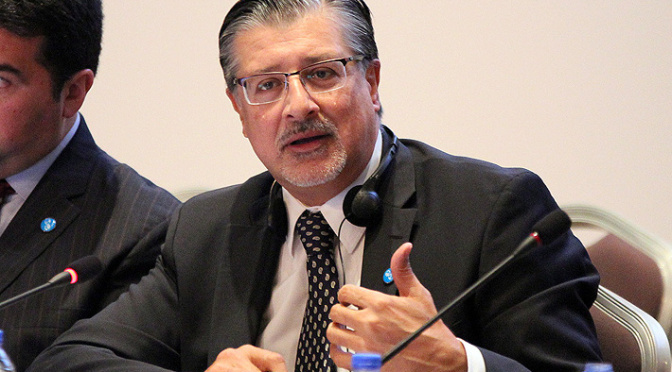
Adnan Z. Amin Re-Appointed as IRENA Director-General
The Director-General of IRENA, Adnan Z. Amin was reappointed today at IRENA’s fifth Assembly to a second four-year term. The reappointment was agreed by acclamation by the 124 IRENA member countries in attendance at the fifth Assembly in Abu Dhabi.
Mr. Amin was appointed as the first Director-General of IRENA in April 2011. His new term will run from April 2015 to April 2019.
“The importance of IRENA’s mission grows apace with the need for rapid renewables expansion across the globe,” said German State Secretary Rainer Baake. “The members of IRENA see the Agency as the key driver for the global energy transformation. IRENA has shown tremendous progress in this regard and I look forward to continued collaboration with the Agency under Mr. Amin’s able leadership.”
Since Mr. Amin was first appointed, IRENA membership has increased from 64 members with two countries in accession to 139 members (138 States and the European Union) with more than 30 countries in accession and has established a robust programmatic framework in support of its global mission.
IRENA Fifth Assembly Opens – 1,000 Delegates Push Renewables Expansion
Government leaders from 150 countries and representatives from more than 110 international organisations gathered in Abu Dhabi today for the opening of the fifth Assembly of the International Renewable Energy Agency (IRENA). The Assembly, the Agency’s ultimate decision-making authority, brings together the international community to speed the global renewable energy expansion and address global challenges including climate change, energy access and energy security.
“The story of renewables is rapidly evolving and as the importance of renewable energy grows, so does the relevance of the Agency’s work,” said IRENA Director-General Adnan Z. Amin at today’s opening ceremony in Abu Dhabi. “The Assembly is an annual pinnacle for the Agency and its future work.”
“I strongly hope that IRENA will play a central role in leading the world to leverage the full potential of renewable energy and thus help the world balance economic growth and the mitigation of climate change,” said H.E. Yoichi Miyazawa, Japanese Minister of Economy, Trade and Industry and Co-President of the Assembly. “The IRENA Assembly offers an unmatched international platform to discuss the challenges and solutions of global adoption of renewable energy.”
“We’re determined to take a leading role in the field of renewable energy, while enhancing cooperative relations with IRENA,” added H.E. Yasuhide Nakayama, State Minister for Foreign Affairs of Japan and the other Co-President of the Assembly.
The Assembly will discuss IRENA’s strategic and programmatic direction in the context of its longer-term vision to promote the uptake of renewable energy, and examine the issues countries face in transitioning to a sustainable energy future.
Highlights of this year’s Assembly include: the launch of multiple IRENA reports including Renewable Power Generation Costs 2014 and Renewable Energy in the Water, Energy & Food Nexus; the announcement of five renewable energy projects in developing countries receiving loans under the second round of the IRENA/Abu Dhabi Fund for Development Project Facility; the launch of REsource, a search engine on all things renewable energy; an invitation-only special panel event with the Financial Times titled “Innovation, Technology, Business and the Future of Renewable Energy”.
Special guest speakers this year include Kandeh Yumkella, Special Representative of the UN Secretary General and Chief Executive of the Sustainable Energy for All initiative; Maria van der Hoeven, Executive Director of the International Energy Agency; Christiana Figueres, Executive Secretary of the United Nations Framework Convention on Climate Change; Christian Bach, Executive Secretary for the United Nations Economic Commission for Europe; Shamshad Akhtar, Executive Secretary of the United Nations Economic and Social Commission for Europe; Fernando Ferreira, Executive Secretary of the Latin America Energy Organisation.
IRENA fifth Assembly documents: www.irena.org/Assembly/5thAssembly.aspx
