All posts by TeamIRENA

Africa’s Power Sector Needs Long-term Planning, Data & Collaboration

“I can see that Africa’s energy poverty is posing great challenges. Every time we think we are making progress, we have a power outage. It’s a painful thing to go through, and why do we? Lack of planning.” – Mahama Kappiah, Director General, ECREEE

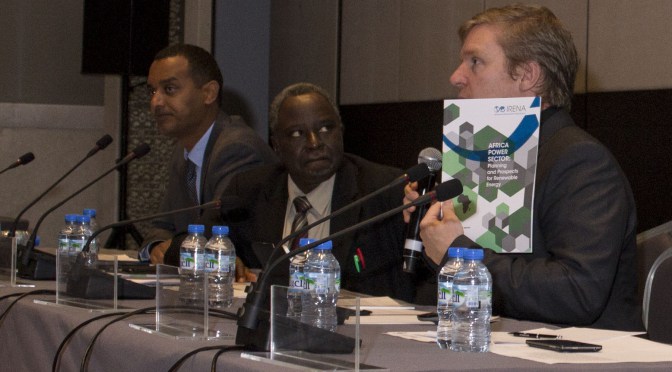
The need for, and solution to, comprehensive energy planning in Africa was the main issue discussed at a pre-Assembly event today in Abu Dhabi. African leaders and international organizations attended Planning Renewable Energy Strategies: Africa Power Sector, to discuss how best to improve energy access and security on the continent.

Speakers underscored the lack of adaptable, realistic energy plans for the continent, the need for more substantive data in the power sector and the lack of coordination between government and industry. Lack of planning often results in expensive short term solutions, which can have significant adverse economic impacts.

Accordingly, speakers proposed the use of updated data and tools in long-term planning, collaboration with academia and governments, and a commitment to capacity building. It was also discussed that master plans must be built on consensus across energy sector stakeholders to increase investor confidence and attract finance.

As one possible solution, IRENA presented its energy system analysis tools – the Systems PLAnning Test (SPLAT) models – that apply to all continental African countries and assesses long-term renewable investment. SPLAT models are built on IRENA’s renewable energy databases and linked with other IRENA tools to ensure the best data available. They can be used to prepare national long-term energy plans, the very need expressed during the event today.

In closing, event attendees proposed that IRENA, the International Atomic Energy Agency, and the KTH Royal Institute of Technology to collaborate and share their research and statistics in the future.

For more information on IRENA’s renewable energy data and statistics visit REsource, the new renewable energy “Google”.

Leaders Discuss How to “Tap” Renewable Energy Resources in Latin America

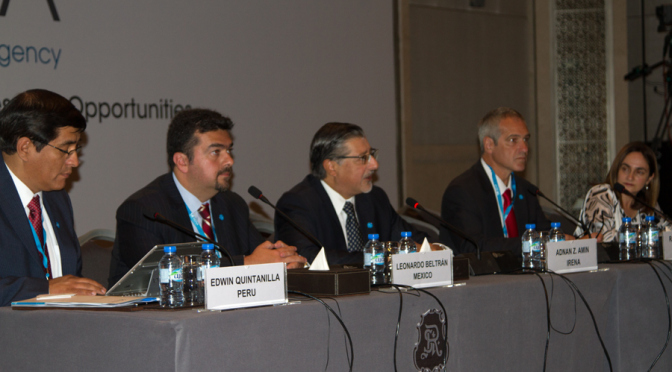
Today in Abu Dhabi, government leaders and organizational representatives from across Latin America met to discuss scaling up renewable energy in the region. Energy demands in Latin America are expected to increase 30% by 2030, a need that can be met by renewable energy says IRENA Director-General Adnan Z. Amin:

“We are following attentively the energy developments in the region, which is closely linked with the positive trajectory in the growth of the Latin American economies. The region is endowed with vast renewable energy resources, and while renewables already contribute significantly to the primary energy supply mix in the form of hydropower and bio energy, the potential is still not fully utilized.”

IRENA’s REmap2030 report suggests that renewable energy in Latin America can increase 240% by 2030. Despite the renewable energy potential, the region relies heavily on fossil fuel-based thermal generation, while wind and solar energy resources remain largely untapped. Latin America has some of the best wind resources in the world, and a number of markets, such as Brazil, Chile, Mexico, Uruguay, Nicaragua and Panama are emerging strongly.

The session presented a working paper on renewable energy in Latin America, which will be edited based on today’s outcomes and published as a report later this year.

The paper highlighted that Latin American countries, compared to the OECD, have a lower energy consumption per capita, however the growth rate is higher, and energy intensity has not changed much in the last 5 years. This means that energy consumption will increase greatly in the coming years, which will strain the existing energy production systems.

Some of the challenges that must in the region include:

  • developing a business case for renewable energy technologies vis-à-vis competing energy resources;
  • creating enabling regulatory and administrative frameworks to promote investment;
  • addressing infrastructure constraints (including the expansion of electricity transmission networks to access remote sources of renewable electricity); and
  • tackling technical challenges of scaling-up of renewables, including institutional capacity building, lack of data on renewable energy potential, lack of technological standards and norms and issues with certification of equipment.

Uruguay, Costa Rica, Mexico, Peru, IGA and OLADE (Latin America Energy Organization) were among those involved in the discussion.

IRENA is involved in a number of activities to help develop the untapped renewable energy capacity in the Latin America region. A Renewables Readiness Assessments (RRA) was completed for Peru last year, and an RRA for Nicaragua will be released soon. IRENA’s REmap2030 report also considered large Latin American economies including Ecuador, Brazil and Mexico.

Further discussions on scaling up global renewable energy expansion continue tomorrow, with the start of IRENA’s fifth Assembly.

US Can More Than Triple Share of Renewable Energy by 2030

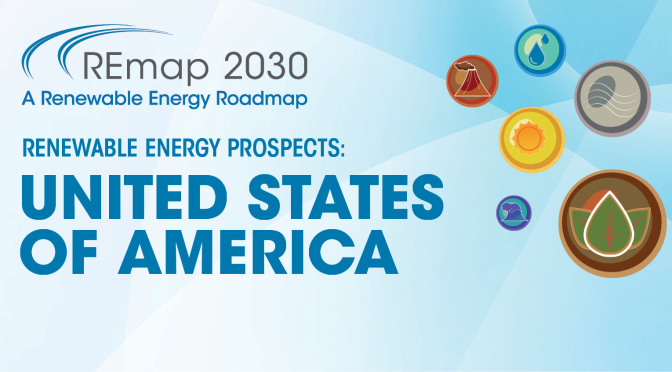
A new report released today by IRENA indicates that the United States could affordably increase its renewable energy share from 7.5% in 2010 to 27% by 2030. Renewable Energy Prospects: United States of America also finds that with progressive policies implemented, the US could increase its use of renewable energy in power generation from 14% to almost 50% by 2030, positioning it as the world’s second largest renewable energy user after China.

“As the second largest energy consumer in the world, the US must continue to play a leading role in the global transition to a sustainable energy future,” said Adnan Z. Amin, IRENA’s Director-General. “The recent agreement between the US and China to reduce greenhouse gas emissions is a ground-breaking step, but the report aims even higher, showing that more can be done at limited cost.”

As of now, the share of renewable energy in the US energy mix will only reach 10% by 2030. An annual investment of USD 86 billion between now and 2030 is required to reach the 27% renewables mark – an increase of USD 38 billion annually, according to the report. The higher renewable investment would be offset by gains in human health and reduced emissions, with an estimated annual savings of USD 30 to 140 billion by 2030.

The report is part of REmap 2030, which provides a plan to double the share of renewable energy in the world’s energy mix by 2030 and determines the potential for the US and other countries to scale-up renewable energy in the energy system, including power, industry, buildings, and the transport sector.

“REmap 2030 shows that the US could install significantly higher amounts of renewables – and that it can do so affordably,” said Mr. Amin. “Even in a country with cheap shale gas like the US, renewable energy is still cost competitive and reduces air pollution, enhances energy security, benefits the economy, and plays a leading role in fighting climate change.”

Next week, efforts to increase momentum toward global renewable energy expansion continues as government leaders from more than 140 countries and representatives from 110 international organisations gather in Abu Dhabi for IRENA’s fifth Assembly.

IRENA Gears Up For Fifth Assembly – Topics, Schedules, Documents

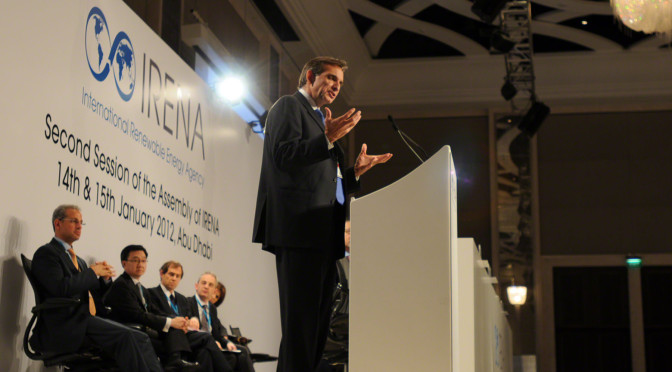
Ministers, senior officials and representatives from 150 countries and 115 organizations will meet this month at IRENA’s fifth Assembly to discuss the urgent need and increased business case for rapid renewable energy expansion.

Taking place 17-18 January, 2015 at the St. Regis Hotel in Abu Dhabi, this year’s Assembly seeks to speed the global renewable energy expansion to address global challenges including climate change, energy access and energy security.

During the Assembly, multiple IRENA reports will be launched including:

Renewable Power Generation Costs 2014
Renewable Energy in the Water, Energy & Food Nexus

In addition, five renewable energy projects in developing countries will be awarded loans under the IRENA/ADFD Project Facility, and REsource, a new search engine on all things renewable energy, will go live.

IRENA and the Financial Times will also host an invitation only Question Time Debate on innovation, technology, business and the future of energy. The event will be held at Abu Dhabi’s Al Bateen airport, under the wing of the Solar Impulse plane.

The two-day Assembly marks the opening of Abu Dhabi Sustainability Week (ADSW), the largest sustainability gathering of global policy makers and business leaders in the Middle East. During this week, IRENA will hold 13 side events, offer expert briefings, and issue reports on renewable energy issues daily at the IRENA booth in the Abu Dhabi National Exhibition Centre.

Information/documents on the Fifth Assembly
IRENA Assembly and ADSW Schedule

IRENA Newsroom

Welcome to IRENA’s blog on all things renewable energy.

Who are we? The International Renewable Energy Agency (IRENA) is an intergovernmental organization with 147 Member States (146 countries and the European Union). We promote the adoption and sustainable use of all forms of renewable energy in the pursuit of sustainable development, energy access, energy security and low-carbon economic growth and prosperity. Learn more at www.irena.org.

The Switch to Renewable Power is a Battle We Cannot Afford to Lose (Op-Ed by IRENA Head)

(This article originally appeared in The Guardian on 24 December, 2015.)

AdnanZ-AminSince the final gavel fell at the Lima climate talks earlier this month, discussions have centred on one question: what did the talks actually accomplish?

After two weeks of intense negotiation, governments settled on a draft text that will hopefully lead to a successful global climate deal in Paris next December. While opinions vary regarding the success or failure of the outcome, there is another story emerging outside the negotiation room.

This year’s conference represented a highly-significant shift in the positive momentum to act on climate change. While negotiators engaged in contentious debates, businesses, non-governmental organisations and local authorities stepped forward to present their own climate initiatives and committed to more action on the ground.

In this shift, renewable energy took centre stage.

According to the Nazca Climate Action portal (named after Peru’s famous geoglyphs), 319 cities and 261 companies are taking action on climate change. Of the 913 total actions recorded so far, 402 relate to energy efficiency and 242 relate to renewable energy.

Private sector initiatives – such as RE100 and the Global Investor Statement on Climate Change – have also emerged to encourage businesses and investors to phase out fossil fuels in favour of renewable energy.

National governments are following suit. Peru plans to generate 60% of its electricity from renewable sources by 2024; Chile doubled its total renewable power capacity in 2014; Germany and Sweden will be carbon-free by 2050. The list goes on, including 144 countries with renewable energy targets, 50 countries supporting a total phase-out of carbon emissions by 2050 and 100 countries supporting zero emissions by 2100.

This action, and the hope it generates for an attainable solution to climate change, is being partly fuelled by the increasingly strong business case for renewable energy. Renewable energy is now the most cost-competitive source of power in many parts of the world.

In Dubai, solar-generated electricity reached a record-low price of six cents per kilowatt hour at an auction in November, cheaper than gas and coal. Similar low prices were achieved for solar power in Brazil in October.

Research by the International Renewable Energy Agency (Irena) shows that a doubling of the world’s share of renewable energy by 2030, from about 18% in 2010 to 36%, would help avoid the worst effects of climate change and would be cheaper than not doing so.

When considering factors like the cost of ill health and environmental damage due to pollution, switching to renewable energy could save up to $740bn (£476bn) per year by 2030. If these costs were factored into energy prices, renewable energy and energy efficiency measures would be cheaper than fossil fuel alternatives.

Beyond cost, renewable energy improves public health and security, creates jobs, and boosts economic growth. Irena research finds that renewable energy jobs reached 6.5m globally in 2013 (the coal sector employed 7m people in the same year) and if steps are taken to double the share of renewable energy, this number could top 16m by 2030.

The momentum and action on renewable energy initiatives was not completely missed by negotiators in Lima. A carbon-free future is now formally part of the negotiations with the need to phase out fossil fuels considered one of the options in the draft negotiating text.

While this is a good first step, the emerging momentum must be injected further into the political discourse to fuel the agenda on climate action and spur a rapid transition to a low carbon future. Putting a price on carbon to create a level playing field for clean energy solutions will be an important driver of that agenda.

To accelerate the scale-up of renewables to the level required to avoid the worst effects of climate change, we need urgent, bold steps, from leaders willing to take the short-term hits from those who would rather carry on with business as usual. This needs to happen at global and local levels, engaging everyone from governments and corporations to investors and individuals.

Vested interests and short-term thinking must be overcome. It will be a battle. But it is a battle we simply cannot afford to lose.